Build a trusted foundation for Threat Exposure Management with comprehensive asset intelligence, informed prioritization, and orchestrated remediation.
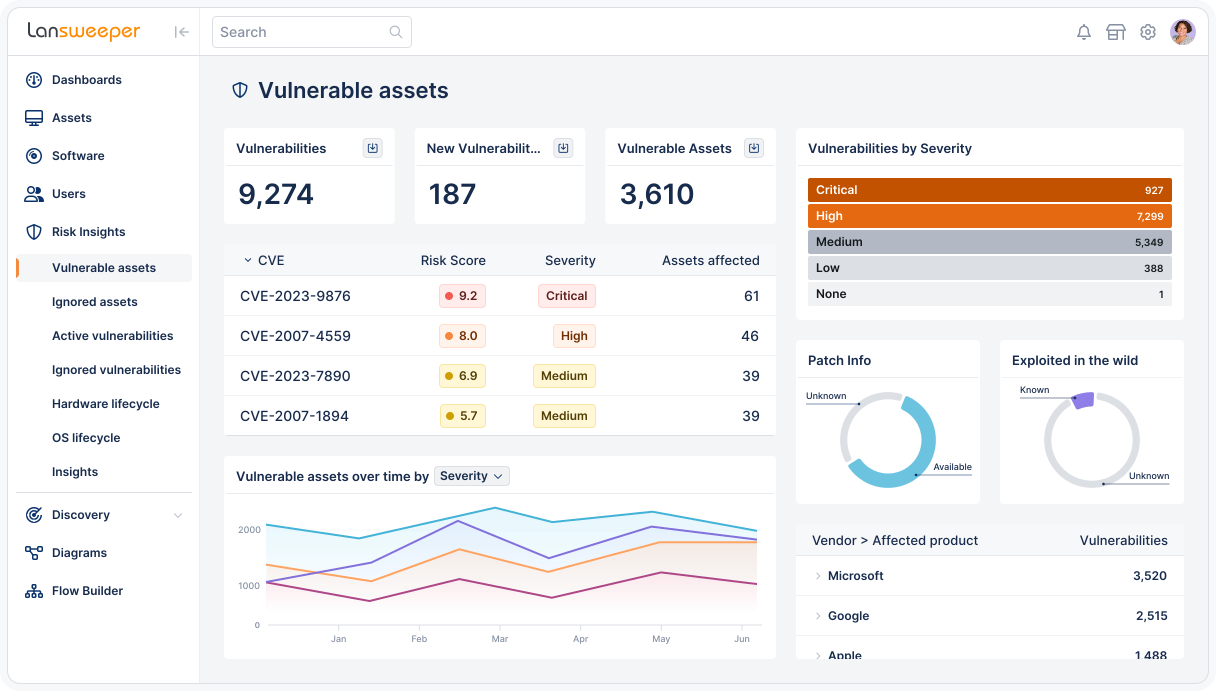
Uncover hidden vulnerabilities across your network with Lansweeper’s comprehensive asset visibility.
Tailor risk management to your needs with customizable prioritization. Address the most critical threats first for maximum protection.
Streamline risk reduction with seamless integration into your existing tools. Mitigate vulnerabilities swiftly and effectively.
Stay on top of vulnerability resolution and keep your security posture strong with security-focused audit reports.

Total Asset Coverage
Threat Exposure Management starts with knowing exactly what exists. Lansweeper discovers IT, OT, IoT, and cloud assets across distributed environments, normalizing and enriching data to ensure consistent vulnerability correlation and eliminate duplicate or conflicting records.

Rich Exposure Context
Severity scores alone don’t tell you what to fix first. Lansweeper automatically enriches and correlates vulnerability data (CVSS, EPSS, exploitability signals, and patch references) with asset ownership, lifecycle stage, and business grouping, so teams protect what matters most.
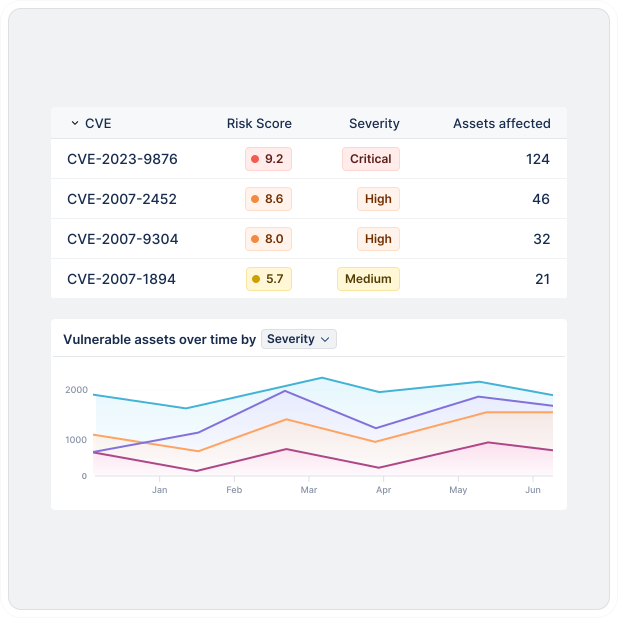
Risk Prioritization
Generic vulnerability lists produce noise, not priorities. Lansweeper lets you build tailored prioritization models using filters, sorting, and contextual asset attributes. Teams can assess the potential blast radius of any vulnerability across connected systems and identify remediation choke points. Collective Intelligence adds benchmarking insight to measure TEM maturity and progress over time.

Orchestration
Lansweeper integrates with ITSM, security, and endpoint management platforms — enriching tickets and workflows with validated asset context. Flow Builder enables low-code automation. Post-scan validation confirms remediation actions, strengthening governance and demonstrating continuous Threat Exposure Management improvement.
How it works
Discover every asset, understand what’s at risk, and push trusted data to the tools that take action.


Continuously discover and classify every asset across IT, OT, cloud, and IoT, including managed, unmanaged, and shadow assets without manual effort.
Normalize and apply context, vulnerability data, and lifecycle signals to assess risk, forecast spend, and surface optimization opportunities.
Deliver trusted asset intelligence to ITSM, CMDB, and security tools so actions are accurate, scoped, and prioritized.
INTEGRATIONS
Lansweeper feeds trusted, continuously updated asset intelligence into the tools that take action.







Explore Lansweeper for free.
No credit card required.
Threat Exposure Management (TEM) is a proactive, continuous strategy for identifying, prioritizing, and validating an organization’s digital risk exposure, going beyond point-in-time vulnerability scanning to build a systematic, measurable approach to reducing attack surface.
Effective TEM depends on complete asset visibility, business-contextualised prioritization, and validated remediation. Lansweeper supports TEM by providing the continuously validated asset intelligence that makes each of these steps reliable: discovering every asset, enriching vulnerability data with ownership and business context, and confirming fixes after each scan.
Lansweeper improves Threat Exposure Management outcomes by closing the three gaps that most programs struggle with. First, it eliminates asset blind spots by ensuring every device, workload, and identity is visible and included in exposure assessments.
Second, it enriches vulnerability data with CVSS, EPSS, exploitability signals, asset ownership, and business criticality so remediation focuses on the attack paths that most meaningfully reduce risk rather than simply the highest severity scores.
Third, it validates remediation post-scan to confirm that fixes were applied and providing defensible evidence of exposure reduction.
Yes. After each scan, Lansweeper updates asset and vulnerability data to reflect the current state of the environment. It allows teams to confirm which patches were applied, which configuration changes took effect, and where exposure still remains. This post-scan validation provides the evidence trail needed to demonstrate measurable Threat Exposure Management progress to leadership, auditors, and compliance frameworks including NIS2 and DORA.
Lansweeper discovers and validates assets across on-premises, cloud, OT, and hybrid environments without performance constraints. It supports environments from hundreds to hundreds of thousands of devices. Native integrations with ITSM, SIEM, and security platforms, combined with Flow Builder automation and open APIs, allow Threat Exposure Management workflows to scale without multiplying manual effort.
Customizable dashboards and HVMND collective intelligence benchmarking help enterprises align TEM with compliance and governance requirements and measure programme maturity over time.