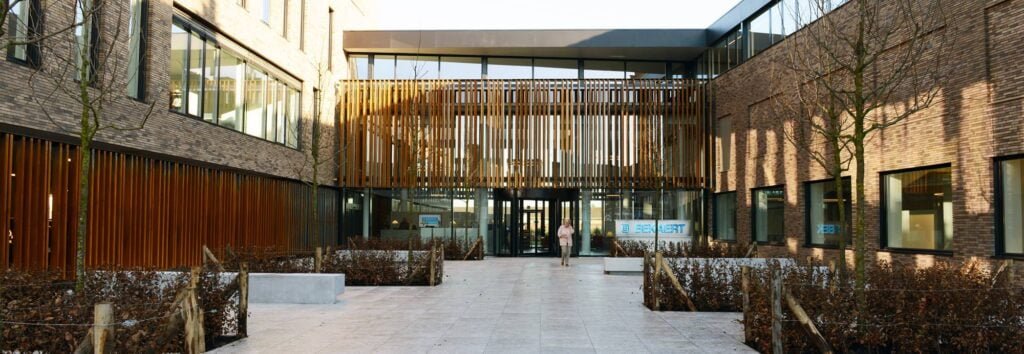
Bekaert, a global leader in steel wire transformation and coating technologies, supplies critical materials to industries ranging from construction to automotive. About 25% of the world’s tires contain Bekaert steel wire.
As the company expanded its digital footprint and cybersecurity expectations intensified, they needed a reliable, cost-effective way to achieve complete asset visibility across a global IT landscape.
“Lansweeper has fundamentally changed how we work and given us the visibility we need to operate securely and efficiently.” – Koen Vereeken, Global IT Lead Infrastructure, IoT, Data Science & AI
After evaluating market options, Bekaert selected Lansweeper for its unmatched IT asset discovery capabilities and data accessibility. With Lansweeper at the core and ManageEngine supporting broader ITSM modernization, Bekaert established a unified, trustworthy asset inventory that now powers cybersecurity, lifecycle planning, and digital transformation across the enterprise.
In the years following the pandemic, cybersecurity expectations across the manufacturing sector increased significantly. Customers, regulators, and auditors all demanded stronger accountability, and nearly every review surfaced the same underlying issue: Bekaert didn’t have a unified, reliable source of asset data.
“Every audit and every customer assessment kept exposing the same gap,” said Koen Vereeken, Global IT Lead Infrastructure, IoT, Data Science & AI. “Our data lived in different systems and spreadsheets, and we were never fully confident we had 100% of our assets accounted for.”
Consolidating these sources required significant manual work, and the results were never fully trustworthy.
Because of this lack of visibility, security teams could not guarantee full coverage in patching or vulnerability management. Project teams struggled to plan lifecycle upgrades, and procurement lacked a consistent view of asset status. Each time the data was exported or merged, quality suffered – even more so when teams attempted to reshape it to meet stakeholder needs.
With cybersecurity demands and operational complexity increasing, Bekaert needed a modern IT Asset Management (ITAM) foundation that could deliver accurate, real-time visibility and support automation across global operations.
During the RFP process, the team noticed that many tools focused heavily on software license management – a straightforward business case. However, these platforms lacked strength in reporting and data accessibility.
Koen and his team needed something fundamentally different: a system that prioritized hardware and software asset discovery at scale while making clean, enriched data available to any downstream system.
“During our RFP, it quickly became clear that Lansweeper was the leader in IT asset management fundamentals,” Koen said. “It gives us direct access to the underlying data – every table and every field – so we can build any report we need and feed accurate inventory data into security, lifecycle, ITSM, and compliance workflows.”
“During our RFP, it quickly became clear that Lansweeper was the leader in IT asset management fundamentals. It gives us direct access to the underlying data – every table and every field – so we can build any report we need and feed accurate inventory data into security, lifecycle, ITSM, and compliance workflows.”

Lansweeper has become Bekaert’s trusted asset inventory, providing reliable visibility into devices across every region, and enabling greater accuracy and significant operational improvement. Bekaert’s patching and vulnerability workflows benefit from complete, reliable asset data, enabling KPI-driven security processes that ensure every device is identified, tracked, and remediated across the global environment.
This level of insight allows teams to eliminate blind spots, identify unmanaged endpoints, and ensure that no device – IT, OT, or IoT – is overlooked. Lansweeper also enriches asset data automatically, eliminating reliance on manual consolidation or outdated spreadsheets.
Bekaert’s ITSM, procurement, and security teams now rely on Lansweeper as their primary reference point. Previously, each department consulted its own data source, then spent hours reconciling those differences. Today, teams work from a single, authoritative dataset that is continuously updated and always accurate.
“Lansweeper has fundamentally changed how we work and given us the visibility we need to operate securely and efficiently,” Koen said.
Asset visibility using Lansweeper has also improved execution across large operational projects, such as Bekaert’s global Windows 11 upgrade. The IT team built a Power BI dashboard that pulled data directly from Lansweeper, giving stakeholders a real-time project tracker and the ability to identify devices needing upgrades, monitor deployments, and anticipate challenges without manual reporting. This data-driven approach eliminated delays and helped the project stay on schedule.
“Before Lansweeper, every time we tried to merge or pivot data across tools, we lost quality,” Koen said. “Now we rely on one trusted source, and that’s preserved both accuracy and efficiency in everything we do.”
Bekeart’s next major frontier is OT asset management. As a manufacturing organization, the company has a large operational technology footprint, and the team views Lansweeper’s discovery capabilities as a critical component of bringing those assets into a unified inventory.
Koen also sees a significant opportunity in combining Lansweeper with enterprise architecture and AI initiatives. With the acquisition of Redjack and Lansweeper’s expanding capabilities, he believes the platform will help bridge asset data with business value.
“We see huge potential in combining Lansweeper with our enterprise architecture and AI initiatives,” Koen said. “We already have the asset data. Now we want to layer business context and intelligence on top of it so we can make stronger, faster decisions across the organization.”