Gain a complete, non-disruptive view of Operational Technology and IT assets across your critical infrastructure environment.
OT Discovery
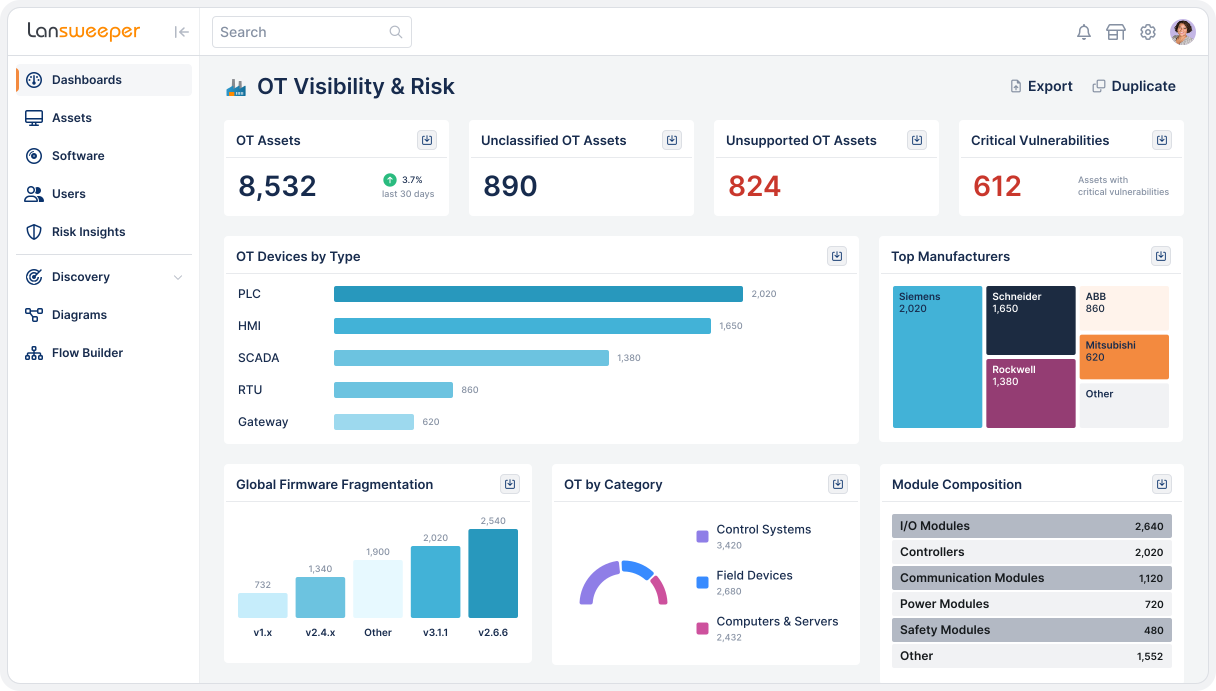
Lansweeper integrates OT protocols from leading manufacturers like Siemens, Rockwell Automation, Mitsubishi Electric, Schneider Electric, and more, into its discovery engine. Every OT asset is automatically identified and catalogued, agentless, without disrupting operations or requiring manual input.

Non-intrusive Scanning
OT environments require low-latency, non-intrusive asset discovery to ensure business continuity. Lansweeper integrates with industry-leading OT protocols from Siemens, Rockwell Automation, Mitsubishi Electric, and Schneider Electric, enabling passive network scanning without interfering with production systems.
OT Security
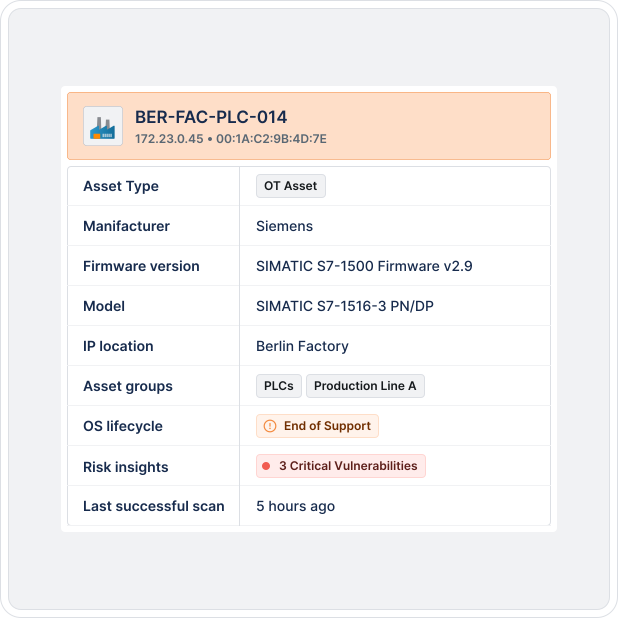
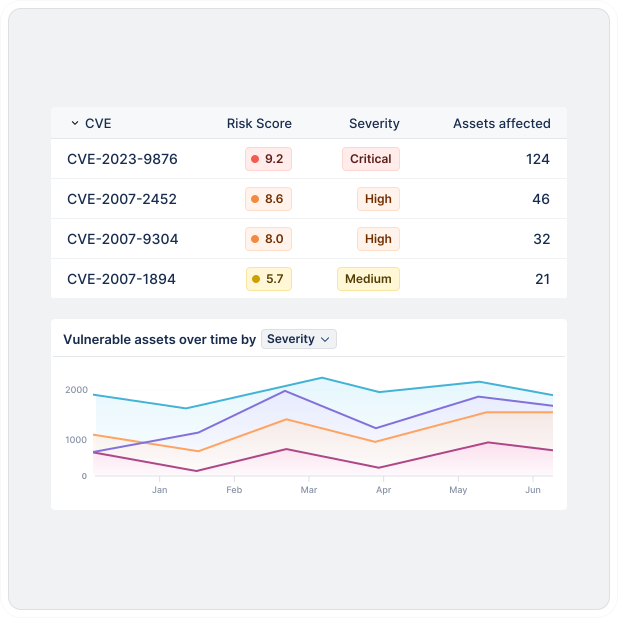
OT assets that aren’t regularly updated are high-value targets. Lansweeper’s Risk Insights surfaces known vulnerabilities, outdated firmware, and missing patches across every connected OT device, so teams can prioritize OT security and reduce the attack surface before an incident forces the issue.

OT Lifecycle Management
Critical OT asset failures cause production delays, financial losses, and reputational damage. Lansweeper tracks lifecycle status, obsolescence risk, and end-of-support dates for every OT device, enabling proactive maintenance, timely replacement planning, and optimized resource allocation before failures occur.

OT Compliance
OT environments face increasing scrutiny under NIST, IEC 62443, CIS, and other frameworks. Lansweeper continuously checks OT devices and configurations against predefined security benchmarks, flagging deviations automatically so teams demonstrate compliance with evidence.

Orchestration
Lansweeper’s extensive integrations with security tools, IT service management (ITSM) platforms, and automation workflows allow organizations to extend their asset intelligence across the entire IT-OT ecosystem. Whether managing vulnerabilities, responding to threats, or automating asset tracking, Lansweeper provides a central hub for orchestrating IT and OT operations.
How it works
Discover every asset, understand what’s at risk, and push trusted data to the tools that take action.


Continuously discover and classify every asset across IT, OT, cloud, and IoT — managed, unmanaged, and shadow — without manual effort.
Normalize and apply context, vulnerability data, and lifecycle signals to assess risk, forecast spend, and surface optimization opportunities.
Deliver trusted asset intelligence to ITSM, CMDB, and security tools so actions are accurate, scoped, and prioritized.
INTEGRATIONS
Lansweeper feeds trusted, continuously updated asset intelligence into the tools that take action.








Explore the full platform, free for 14 days.
No credit card required.
OT asset management is the practice of discovering, inventorying, and managing operational technology (OT) assets, including industrial control systems (ICS), programmable logic controllers (PLCs), SCADA systems, and other connected operational equipment, to maintain visibility, manage security risk, and ensure operational continuity. OT asset management is distinct from IT asset management because OT devices often run legacy protocols, cannot support agents, and operate in environments where disruption carries physical and safety risk.
OT environments present unique discovery challenges: many devices run proprietary or legacy protocols (Modbus, DNP3, Profinet) that standard IT scanners don’t understand. OT assets often can’t support software agents due to hardware constraints or vendor support restrictions. Environments are frequently air-gapped or segmented from IT networks. And OT discovery must be passive or low-impact: active scanning that disrupts traffic in an OT environment can cause operational failures. Lansweeper’s network-level discovery identifies OT assets safely, without sending traffic that could disrupt industrial processes.
Lansweeper discovers OT assets using network-level passive and active scanning that is safe for OT environments, identifying devices by their network presence, protocols, and behavior without requiring agents or causing operational disruption. It recognizes a wide range of OT device types and vendors, captures available configuration data, and maps OT assets alongside IT assets in a single, continuously validated inventory. IT and OT security teams share this trusted view of the full technology estate, no separate tools, no manual reconciliation.
You can’t protect what you can’t see. OT environments are increasingly targeted by threat actors because they’re connected, directly or indirectly, to IT networks, and because many OT devices run outdated firmware with known vulnerabilities and no patch path. Security teams can’t prioritize OT risk without knowing which devices are present, what firmware versions they’re running, and how they connect to the broader network. Lansweeper’s OT asset inventory gives IT and Security the shared, trusted visibility foundation that OT security programs depend on.
As IT and OT networks converge, the attack surface expands: OT devices become reachable from IT networks, and threats that originate in IT can propagate into OT environments. Lansweeper discovers and inventories both IT and OT assets in a single platform, giving security and operations teams a shared, continuously validated view of the converged environment. This makes it possible to identify cross-network connections, flag OT devices with IT-sourced exposure, and coordinate incident response across both domains without switching between separate tools.
Several regulatory frameworks require organizations operating critical infrastructure to maintain accurate OT asset inventories. These include IEC 62443 (industrial cybersecurity), NERC CIP (energy sector), and NIS2 (EU network and information security directive). Lansweeper supports compliance readiness by providing a continuously updated OT asset inventory with the device-level detail, including firmware versions, protocol types, network location, and lifecycle status, needed to demonstrate compliance and respond to audit requests without manual data assembly.