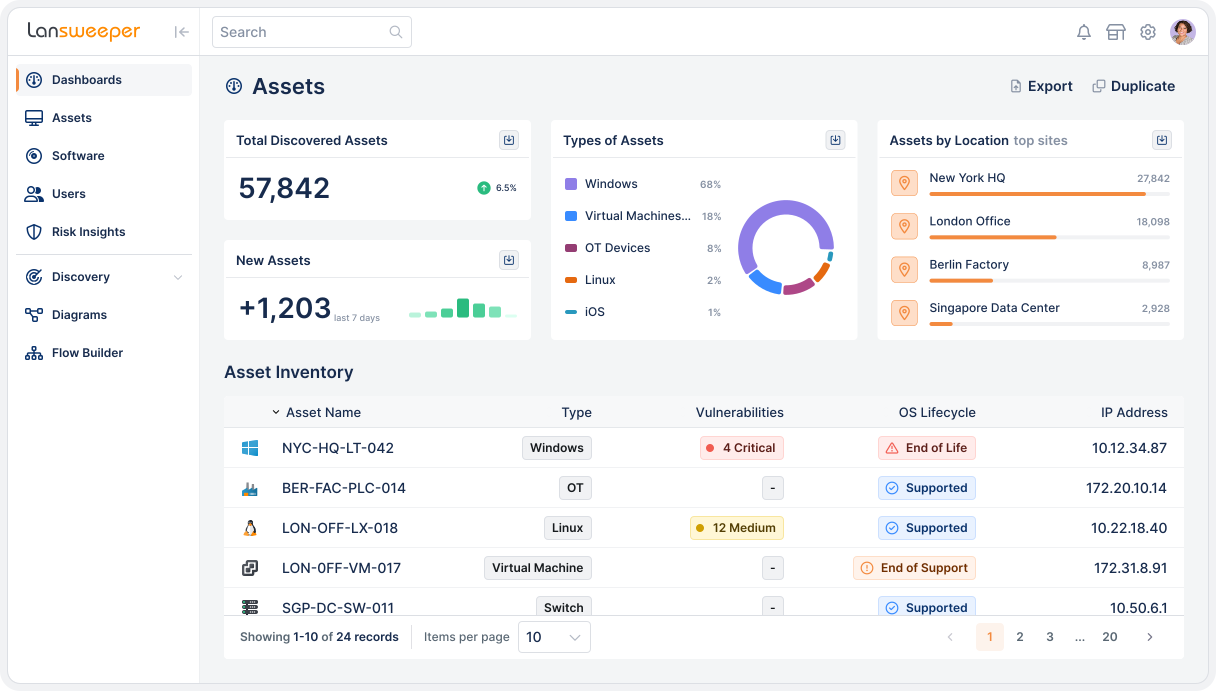
IT and Security work in the same environment, but rarely from the same data. Lansweeper gives both teams one continuously validated source of truth across the entire cyber estate.

Complete Discovery
Lansweeper discovers every device, user, software title, and cloud resource across IT, OT, IoT, and hybrid environments. Nothing remains hidden in data silos, unmanaged segments, or disconnected tools. You gain full-spectrum coverage of your technology estate.

Unified Intelligence
When tools disagree, teams waste time debating data instead of acting on it. Lansweeper normalizes, enriches, and deduplicates asset data automatically, consolidating hardware details, software, lifecycle, and risk signals into one authoritative foundation both IT and Security can trust. This shared intelligence eliminates debate over “which data is correct” and accelerates decision-making.

Continuous Validation
Your technology environments are always changing and so should your inventory. Point-in-time scans go stale the moment they finish. Lansweeper updates continuously, surfacing new assets, configuration gaps, and drift as they happen. IT and Security always operate from a current baseline, not last week’s snapshot.

AI Usage Tracking
AI tools, service connections, and AI-capable hardware are assets, and most of them never make it into a standard inventory. Lansweeper extends total visibility to cover locally installed AI apps, external AI service connections, browser-based usage, and AI-capable devices, tied to individual assets and classified by risk level.
Without a complete, trusted view of what exists, nothing that follows works reliably.
Continuously verify control coverage, detect configuration drift, and surface exposure before it becomes an incident.
Turn security findings into coordinated remediation with clear ownership, operational context, and visibility on both sides.
Accurate, continuously validated asset classification so access policies and segmentation controls are built on facts, not assumptions.
How it works
Discover every asset, understand what’s at risk, and push trusted data to the tools that take action.


Continuously discover and classify every asset across IT, OT, cloud, and IoT, including managed, unmanaged, and shadow assets without manual effort.
Normalize and apply context, vulnerability data, and lifecycle signals to assess risk, forecast spend, and surface optimization opportunities.
Deliver trusted asset intelligence to ITSM, CMDB, and security tools so actions are accurate, scoped, and prioritized.
INTEGRATIONS
Lansweeper feeds trusted, continuously updated asset intelligence into the tools that take action.







Explore Lansweeper for free.
No credit card required.
IT needs complete, trusted data on every managed asset to drive operational efficiency and cost control. Security needs visibility and accurate environment intelligence to identify risk and mitigate vulnerabilities. Lansweeper gives both teams what they need from the same continuously validated source. When IT and Security work from the same foundation, coordination accelerates and decisions get faster.
Total Visibility eliminates the blind spots that slow decision-making, stall remediation, and create exposure. With a complete, continuously validated inventory, teams stop reconciling data and start acting on it. Audit readiness improves. Risk from unknown assets drops. And every downstream tool (patching, ITSM, SIEM, EDR) operates from asset intelligence it can trust.
You can’t protect, manage, or act on what you can’t see. Unknown and unmanaged assets sit outside every security control, as they can’t be patched, monitored, or governed if they’re not in the inventory. Total Visibility is the prerequisite: every use case, from verifying control coverage to enforcing Zero Trust policies, depends on having a complete, trusted picture of what exists.
Lansweeper combines active scanning, passive discovery, lightweight agents, cloud API integrations, and data imports to cover on-prem, remote, OT, IoT, and cloud assets. Over 50 discovery protocols and patented credential-free device recognition ensure complete coverage, without requiring agents on every device or manual configuration for each environment type.