On the 10th of November 2026, both Microsoft .NET version 8 (LTS) and version 9 will be going end of life. This means that these versions of Microsoft’s multi-platform application framework will no longer receive any updates or security fixes in the future. Make sure to update any instances in your network to a supported version.
.NET (formerly .NET Core) is a free, open-source development platform by Microsoft. The framework is cross-platform, meaning that it runs on Windows, macOS, and Linux operating systems. This allows developers to more easily create an application that supports multiple platforms.
.NET Core supports building different types of applications like mobile, desktop, web, cloud, IoT, machine learning, microservices, games, and much more.
The framework is designed to be modular, lightweight, and fast and also includes core features that are required to run any basic .NET Core app. If you want additional features, you can get these with so-called “NuGet” packages, which can be added to the application you are building. This allows applications to be faster, reduces memory utilization, and improves maintenance.
Microsoft publishes new major releases of .NET every year in November. This is done to allow developers and businesses to plan ahead. LTS (Long Term Support) releases, released in odd-numbered years get free support and patches for three years while STS (Standard Term Support, formerly known as Current releases) releases, released in even-numbered years that get free support and patches for only 2 years.
| Version | Release Date | End of Support |
| .NET 10 | Nov 10, 2025 | Nov 14, 2028 |
| .NET 9 | Nov 11, 2024 | Nov 10, 2026 |
| .NET 8 (LTS) | Nov 14, 2023 | Nov 10, 2026 |
| .NET 7 | Nov 8, 2022 | May 14, 2024 |
| .NET 6.0 (LTS) | Nov 8, 2021 | Nov 12, 2024 |
| .NET 5.0 | Nov 10, 2020 | May 10, 2022 |
| .NET Core 3.1 (LTS) | Dec 3, 2019 | Dec 13, 2022 |
| .NET Core 3.0 | Sep 23, 2019 | Mar 3, 2020 |
| .NET Core 2.2 | Dec 4, 2018 | Dec 23, 2019 |
| .NET Core 2.1 (LTS) | May 30, 2018 | Aug 21, 2021 |
| .NET Core 2.0 | Aug 14, 2017 | Oct 1, 2018 |
| .NET Core 1.1 | Nov 16, 2016 | Jun 27, 2019 |
| .NET Core 1.0 | Jun 27, 2016 | Jun 27, 2019 |
.NET 8.0 (LTS) and .NET 9.0 will both be going end of life on the 10th of November 2026. From that point on the only supported release remaining will be .NET 10.0. Make sure to update any instances you have running in order to continue receiving support. You can find more information about the upgrade process right here. .NET 10 is an LTS release and will be supported for 3 years. It also has a number of improvements over earlier versions, including but not limited to:
Our team has put together a report to help you find all Windows or Linux devices in your network that have .NET (Core) installed along with their version. This way you have an actionable list of .NET installations that may still need to be updated. You can get the report via the link below.
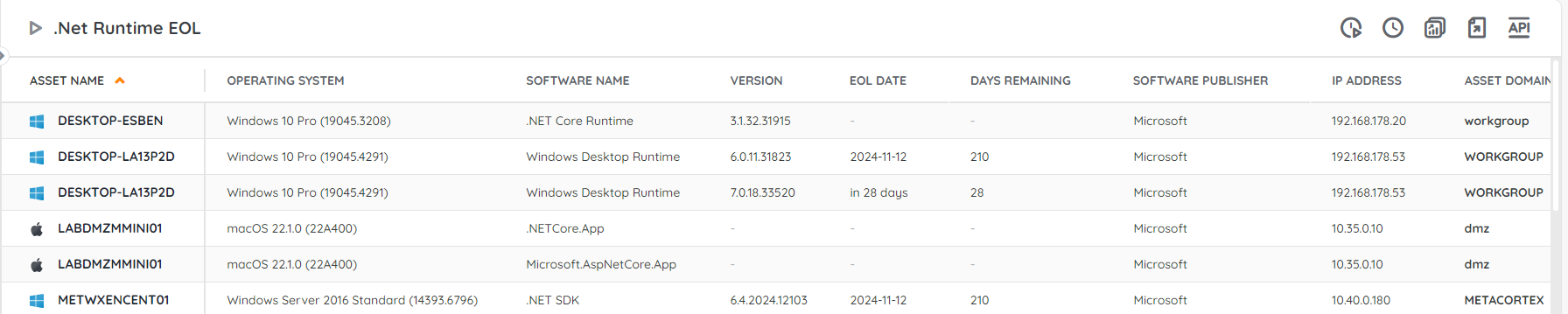
.NET 6.0 (LTS) is reaching its end-of-life date on the 12th of November 2024. Make sure to update any instances of .NET 6.0 (LTS) in your network to version 8 or higher in order to continue receiving support. You can find more information about the upgrade process right here. .NET 8 is an LTS release and will be supported for 3 years. It also has a number of improvements over earlier versions, including but not limited to:
.NET 7 will be going end of life on the 14th of May 2024. Make sure to update any instances of .NET 7 in your network to version 8 or higher in order to continue receiving support. Our .NET End of Life Audit report can help you locate any .NET installations on Windows or Linux that still need to be updated. Microsoft has released a blog with more information about the upgrade process to help you out .NET 8 is an LTS release and will be supported for 3 years. It also has a number of improvements over earlier versions, including but not limited to:
.NET Core 3.1 was released on the 3rd of December, 2019. As it is an LTS release, it received 3 years of support and will be going end-of-life on the 13th of December, 2022. In order to continue receiving support you are advised to update to .NET version 6.0 or higher. You can use our .NET End of Life Audit report to locate any .NET installations on Windows or Linux that still need to be updated. You can find more information about the upgrade process on Microsoft’s blog. If you are migrating apps to .NET 6, you may want to run a compatibility check first .NET 6.0 boasts a number of improvements over earlier versions, including but not limited to:
.NET 5.0 was released in November 2020. The most obvious change is the branding change away from “Core”. The “Core” branding was removed, and version 4.0 was skipped altogether. Microsoft has made it clear that .NET 5.0 would only be supported for 18 months and that period will end on May 8, 2022. As a result, Microsoft will no longer provide fixes, updates, or online technical assistance. To help you ensure that all devices in your IT environment are using a support .Net version, we’ve created a special report that provides an overview of all .Net installations on Windows and Linux along with their EOL status.
.Net Core 2.1 was released back on May 30, 2018. However, it was only declared an LTS release in August 2018. That’s why the end of support is slightly longer than three years. On August 21, 2021, .NET Core 2.1 finally went end of life and users needed to upgrade to .Net Core 3.1 or higher.
Explore Lansweeper for free.
No credit card required.