

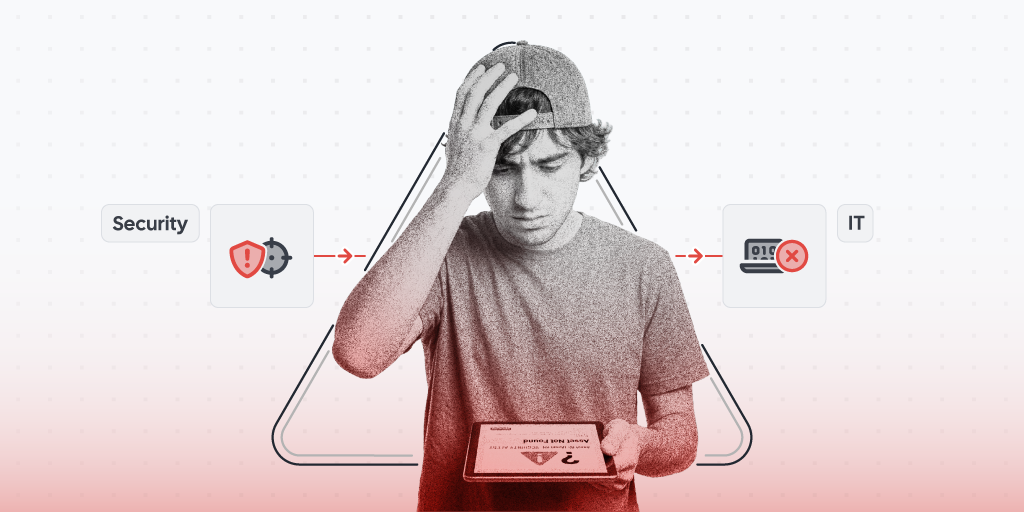
Modern IT teams are under tremendous pressure to fix vulnerabilities immediately, almost as soon as Security teams find them. Attackers have become much more adept at exploiting weaknesses quickly, so there’s no time to waste. The expectation is that IT will apply a patch and eliminate the risk, now.
For IT managers and infrastructure leaders, those investigations aren’t just an operational inconvenience. Every hour spent validating asset identities, confirming ownership, or assessing dependencies extends the organization’s exposure to risk. It also makes it harder to explain to security leaders and executives why a critical vulnerability remains unresolved.
Plus, it’s not as simple as applying a patch, especially when there’s a lack of IT-Security alignment. Before even scheduling a maintenance window, IT has to determine which system (or systems) to fix, who owns them, whether or not the system is used in a production environment, and which applications depend on it. Until they know the answers, their hands are tied.
In other words, remediation doesn’t stall because IT doesn’t act quickly; it stalls because IT has to investigate the ticket before it can take action. To see why, let’s look at a fictional but familiar example.
Imagine a security analyst discovers a critical remote code execution vulnerability on a production web server. A patch has been available for weeks, so they create a Priority 1 ticket and assign it to IT, identifying the affected asset as PRODWEB-042.
However, when the ticket reaches IT, no one can find the server “PRODWEB-042.” It doesn’t exist in their asset inventory, and the hostname doesn’t match anything in the CMDB. No one can determine who owns it, and there’s no business context explaining what the system supports or the potential impact of a change.
So, IT starts investigating the ticket, searching through multiple inventory systems, scouring the CMDB for matching records, verifying ownership with application teams, and identifying downstream dependencies that may be affected by the patch. Before IT can remediate the vulnerability, it has to pave a path forward that won’t introduce operational uncertainty. Meanwhile, the Priority 1 vulnerability remains open, remediation SLAs continue to slip, and leadership sees only that the patch hasn’t been deployed.
From Security’s perspective, IT needs to reduce exposure by remediating the vulnerability as quickly as possible. While IT shares that goal, they also need to keep critical systems up and running. Every remediation decision must balance cyber and operational risk.
Applying a patch too quickly without understanding the environment and operational impacts of the patch can cause lots of new problems. It can interrupt production, break integrations, degrade customer service, or trigger emergency rollbacks.
Meanwhile, IT is already managing maintenance, upgrades, a host of projects and support requests, and other remediation efforts. The patch must be deployed, but it has to be deployed safely, and that requires context.
When vulnerability tickets arrive with a trusted asset identifier, confirmed ownership, and clear business context, IT spends less time investigating and more time planning a safe, efficient remediation.
The better the information at the handoff, the faster IT can reduce cyber risk without introducing operational risk. For IT leaders, that means shorter remediation cycles, fewer emergency changes, and greater confidence when reporting remediation progress to Security and executive leadership.
For IT to act quickly, context is essential, and that starts with IT asset visibility. Before they can begin remediation work, they need answers to three important questions:
Every unanswered question delays remediation, consumes valuable engineering time, and increases the likelihood that critical vulnerabilities will miss internal or regulatory remediation targets.
When Security and IT share the same trusted view of every asset, ownership, and dependency, remediation can begin with planning the fix instead of reconciling conflicting information.
Security Risk Remediation
See what a shared view of your assets makes possible.
The friction between Security and IT stems from each team having different perspectives, and often different data.
Security’s job is attack surface visibility: finding every CVE, exploitability path, and exposure before attackers can take advantage of them. IT is thinking about operations. They have to manage assets, maintain services, coordinate schedules and maintenance windows, and understand production dependencies.
Neither view is wrong, but having diverse perspectives creates friction during handoffs.
When Security identifies an issue using one set of tools and IT manages the environment through another, the handoff requires translation. Failure points include mismatched identifiers, unknown ownership, unclear remediation scope, and conflicting system data. All of these discrepancies have to be addressed before remediation begins.
What’s needed is a shared, continuously validated view of the technology environment that both teams can work from. When Security and IT share trusted asset intelligence, every vulnerability ticket arrives as actionable work instead of another investigation. That allows IT managers to spend less time coordinating across disconnected teams and more time driving measurable reductions in remediation backlog and cyber risk.
The fastest way to improve vulnerability remediation is to eliminate the investigation that usually happens before remediation can begin.
This is what Lansweeper’s Cyber Asset Intelligence Platform is built to do. Instead of serving as a simple asset inventory, it provides a continuously validated, shared data foundation that both Security and IT can trust.
When a vulnerability ticket arrives backed by trusted asset intelligence, it includes all of the information IT needs to take action: a verified asset identity, confirmed ownership, operational context, dependency information, current configuration details, and a clear understanding of the remediation scope.
Imagine the earlier PRODWEB-042 example with that level of context attached to the ticket. With all of the context and asset intelligence on-hand, IT can begin evaluating the change immediately and schedule the maintenance for a safe and timely patch deployment.
Lansweeper eliminates that uncertainty by giving everyone involved a shared, continuously validated view of the technology estate. By shifting the focus from investigation to execution, it enables meaningful improvements in time-to-remediation, operational efficiency, and reporting.
Instead of explaining why vulnerabilities remain open, IT leaders can demonstrate that they’re prioritizing, measuring, and making progress on remediation efforts.
An effective vulnerability remediation workflow is measured by how quickly IT can fix a vulnerability and close a ticket. The less operational friction they have, the more effective they can be. This requires IT-Security alignment.
Access to shared cyber asset intelligence enables teams to prioritize tickets quickly based on security risk and operational impact, prepare change requests, and schedule maintenance windows faster, without first having to ask follow-up questions or hunt down answers. It also gives IT managers the evidence they need to answer difficult questions from CISOs and executive leadership about remediation status, operational risk, and why specific vulnerabilities have (or haven’t) been addressed.
Security Risk Remediation
See what a shared view of your assets makes possible.
Security passes a vulnerability finding to IT for investigation and remediation. The handoff should include enough operational context for IT to identify the affected asset, understand its business impact, and safely plan remediation. When that handoff is incomplete, remediation is stalled. A well-structured handoff helps Security and IT work from the same information, reducing delays and enabling faster, more confident fixes.
Most IT teams struggle because they lack context. A vulnerability ticket may identify a critical issue, but if the asset can’t be located, ownership is unclear, or the business impact is unknown, IT has to investigate before they remediate. The more complete the information arriving with the ticket, the faster IT can start remediation efforts.
IT teams need a trusted asset identifier, confirmed ownership, and a clear understanding of the remediation scope. They need to know whether the system is production, what applications depend on it, and how the change could affect the business. Using a shared and trusted asset intelligence platform, IT receives vulnerability tickets with the operational context they need to prioritize and schedule remediation, and act quickly, without having to investigate the issue.
A vulnerability scanner identifies exposed systems based on network observation and software fingerprints. A CMDB tracks ownership and configuration data maintained by IT teams. Both systems can be accurate within their own scope, yet fall out of sync with each other. Why? Because assets get renamed, IP addresses change, and some systems are deployed outside of IT oversight entirely. With a shared, continuously validated asset foundation, teams can reconcile those differences and act quickly when a new vulnerability is discovered.
Verizon’s 2025 Data Breach Investigations Report cites that vulnerability exploitation has overtaken credential theft as the leading initial access vector. When Security identifies a vulnerability but IT can’t take immediate action, the organization can be exposed to risk. Real-world incidents such as the Equifax breach and more recent SharePoint attacks demonstrate that patches alone aren’t enough. You also need an efficient process for remediating vulnerabilities before attackers have an opportunity to exploit them.
The first step is establishing a shared, continuously validated view of the technology environment, so that both teams work from the same asset information. Next, standardize ownership, prioritize vulnerabilities based on both security and operational impact, and define clear remediation processes that fit existing IT operations.
Several operational issues can delay remediation, including:
Removing these obstacles helps IT spend less time validating information and more time reducing risk.
A structured vulnerability remediation workflow typically follows five steps:
1. Detection: Security identifies and prioritizes a vulnerability.
2. Triage: The affected asset, owner, and business context are validated.
3. Owner assignment: IT confirms ownership and schedules remediation.
4. Remediation: The patch or mitigation is implemented according to change management processes.
5. Verification: Security and IT confirm the vulnerability has been resolved and document the outcome.
When supported by shared cyber asset intelligence, each step becomes faster and easier to manage across both teams.
Blog


Explore the full platform, free for 14 days.
No credit card required.