


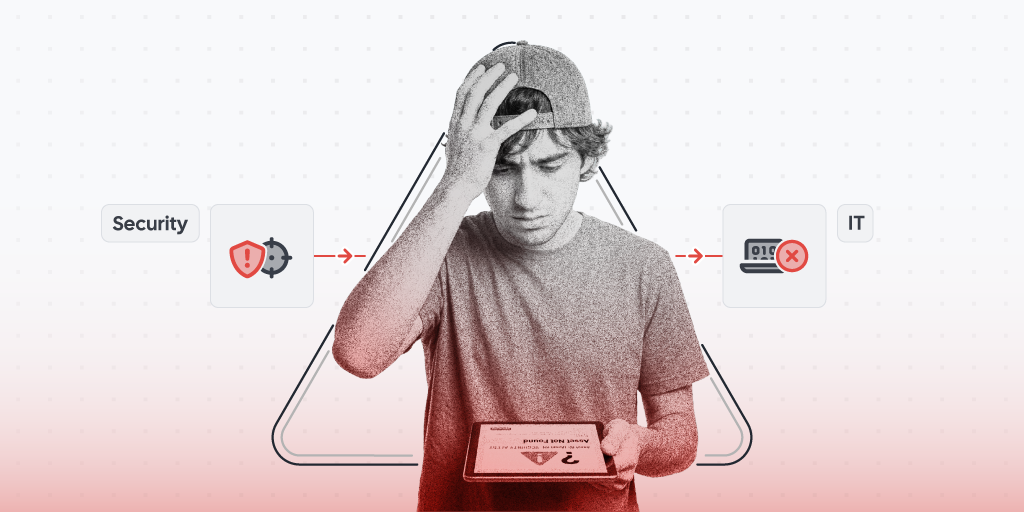
Imagine this common scenario: Your vulnerability scanner identifies a critical CVE on Server-XP-04 and automatically creates a remediation ticket. When IT investigates it, they can’t find that server anywhere in the configuration management database (CMDB). Instead, they found a configuration item called Web-Prod-04, which was marked as retired three months ago. Meanwhile, the virtualization platform shows the workload under yet another identifier.
Before IT can even begin to remediate the vulnerability, they need to answer a very basic question: Are all three systems referring to the same asset?
For IT managers, these investigations consume valuable engineering time, delay remediation SLAs, and make it difficult to explain to leadership why a critical vulnerability remains unresolved, even though Security already identified it.
Unfortunately, this scenario plays out every day in enterprise environments. Vulnerability scanning tools and CMDBs disagree frequently about asset identity, ownership, lifecycle status, and other asset data, even whether or not the asset exists. Those discrepancies slow remediation and complicate audits, creating friction between Security and IT.
Fortunately, those mismatches don’t necessarily point to bad data or broken tools. More often, they indicate a fundamental difference in how each system defines and manages asset data.
This article explores the CMDB vs. vulnerability scanner problem: why the two disagree, why both can be technically correct at the same time, and what your organization can do to improve asset inventory accuracy across your technology stack.
Many organizations expect their vulnerability scanner and configuration management database (CMDB) to maintain identical inventories. When they don’t, some may think it’s a sign that one of the tools is inaccurate or out of date.
In reality, these systems were never designed to produce the same view of the environment. They serve different operational purposes and use different data models. As a result, their definition of asset “truth” is also very different.
Understanding that distinction helps IT leaders focus less on determining which tool is the “right” tool, and instead work to create a trusted operational process that speeds up remediation.
Vulnerability scanners continuously discover and evaluate the current state of the IT environment, looking for available endpoints, installed operating systems and software, exposed services, and the existence of vulnerabilities. They build inventories around observable technical attributes.
Depending on the tool and deployment model, the scanner may identify an asset by its IP address, MAC address, hostname, endpoint agent, cloud instance ID, or operating system fingerprint. It constantly refreshes that data and discovers new information through network discovery and authenticated scans. In this way, it reflects the current technical state of an asset at all times.
If an asset is present and responding to a vulnerability scanner, it exists. This is critical for vulnerability management, because if an attacker can reach an asset, they can exploit it.
Rather than documenting an asset’s current technical state, CMDB asset management provides the operational and business context needed to manage that asset throughout its lifecycle. To the CMDB, an asset is considered valid when it exists as a managed configuration item with established ownership, dependencies, and lifecycle information.
The CMDB tracks:
While a vulnerability scanner answers what is running and what is vulnerable, a CMDB answers who is responsible for it, why it exists, and how it fits into the broader IT environment. That’s why a vulnerability scanner and a CMDB can present very different views of the same asset, both of which can be accurate.
The distinction is important because it explains why a scanner and a CMDB can legitimately disagree. A scanner may detect a server that has been provisioned but not yet onboarded into IT operations. Conversely, a CMDB may still contain a retired configuration item that no longer appears on the network.
In both cases, each system is accurately representing the information it was designed to manage. Neither system is wrong. They’re simply maintaining different data models to answer different operational questions.
Until you reconcile those differences, IT managers will face longer remediation cycles and additional coordination work. They may also find it challenging to demonstrate progress against vulnerability remediation targets.
Security Risk Remediation
See what a shared view of your assets makes possible.
Vulnerability scanners and CMDBs collect, identify, and manage asset data differently, so discrepancies between them are both common and expected. Those differences result in four common technical reasons why the same asset appears differently in each tool.
A vulnerability scanner uses network probes, authenticated scans, endpoint agents, and cloud APIs to determine what assets exist on the network. Meanwhile, the CMDB is building an inventory using discovery connectors, procurement systems, virtualization platforms, IT service management (ITSM) workflows, change management processes, and manual lifecycle updates.
These are very different data sources, so discrepancies are inevitable.
For IT leadership, these differences translate into more manual reconciliation, slower change planning, and less confidence in remediation reporting.
Even when both systems discover the same asset, they may see it differently. The scanner references an IP address, while the CMDB stores a business-friendly configuration item name.
Each identifier is technically correct, but without a way to correlate them, they seem to be describing different assets, resulting in duplicate records and ownership confusion.
Vulnerability scanners provide point-in-time observations of the environment. They refresh the inventory in response to infrastructure changes. A CMDB, on the other hand, maintains governed operational records. It updates its inventory through scheduled discovery jobs or approved change requests. This creates “data drift.”
Case in point: A server may be provisioned on Monday, discovered by the scanner on Tuesday, renamed on Wednesday, patched on Thursday, and finally updated in the CMDB on Friday. Neither system is wrong. Rather, they’re reporting on different points in the asset’s lifecycle.
Hybrid and cloud environments magnify these challenges. For example, autoscaling groups automatically add and remove compute resources based on demand. Containers can be created and destroyed during application updates. Cloud instances may exist for only minutes before being replaced.
Dynamic IP addresses further complicate asset tracking as workloads move between hosts or are reprovisioned. All of these realities can lead to asset mismatches and delay remediation.
When a vulnerability scanner and a CMDB disagree, don’t assume one system contains bad data. Both may be telling the truth – just telling different parts of the story.
Let’s return to our opening example. Say the vulnerability scanner flags a critical vulnerability on Server-XP-04:
These findings are all true, with each system reporting on what it’s designed to manage:
This is an example of relative truth: multiple systems accurately describing different aspects of the same asset.
When these perspectives aren’t connected, IT can’t confidently assign ownership or schedule remediation. Exposure windows widen, and you may miss your remediation SLAs. This can lead to difficult conversations with Security and executive leadership about why critical vulnerabilities remain open.
So what does it take to bring all of the data together? The answer is simple: a single source of truth.
The following architectural principles can help you build a single source of truth to reduce discrepancies and improve vulnerability remediation:
In other words, you don’t need to force every tool to maintain identical inventories. Just make sure they describe the same asset consistently enough that Security and IT can trust the data.
A trusted asset foundation also gives IT managers more reliable remediation metrics for planning and reporting.
As the vulnerability scenario we used in this blog demonstrates, time spent determining which asset needs remediation is often the biggest hurdle to effective remediation. Security and IT must agree on identity, ownership, and status before work can begin.
But agreement can’t be forced. Teams need a platform like Lansweeper to establish that shared understanding, connecting technical discovery with operational context into a single source of undeniable truth.
Security Risk Remediation
See what a shared view of your assets makes possible.
Asset identity mismatch occurs when different tools recognize the same asset as different systems. This is usually because they use different identifiers or data models. A vulnerability scanner may identify a server by its IP address, while the CMDB tracks it by a business-friendly configuration item name. Unfortunately, Security and IT may spend a lot of time determining whether they’re looking at the same asset, delaying remediation.
Vulnerability scanners and CMDBs are designed for different purposes. As a result, they collect and manage different types of information. For example, Scanners focus on real-time technical data, while CMDBs capture operational context such as ownership or lifecycle status. They have different discovery methods, update schedules, and asset identifiers so they can present very different yet accurate views. Without a way to correlate those records, remediation slows because IT must first determine whether multiple systems are describing the same asset.
To reconcile the data, you need to correlate multiple asset identifiers and continuously synchronize technical discovery with operational records. It’s also critical to standardize naming conventions and define authoritative sources for different types of asset data. This way, you create a shared, trusted view of asset identity that your Security and IT teams can trust.
A CMDB provides operational context by documenting ownership, business services, lifecycle status, and relationships between assets. An asset discovery platform continuously identifies hardware, software, cloud resources, and configuration changes across the environment. Asset discovery platforms don’t replace CMDBs; they help it stay accurate by continuously updating the inventory data.
An inaccurate CMDB can delay vulnerability remediation by making it difficult to identify the correct asset or assign ownership. Prioritization also becomes challenging. As a result of the delay, the organization is exposed to the threat longer, increasing the likelihood of a breach. Incomplete or outdated asset records can lead to blind spots that leave some systems unmanaged and unprotected.
To maintain an accurate CMDB, you need continuous discovery. Cloud resources, virtual machines, and endpoints are continuously being added, changed, or retired, and those updates should flow automatically into your operational records. While regular reconciliation and data normalization can ensure the CMDB is aligned with the current state of the environment, continuous discovery is preferable.
Organizations need clear ownership, consistent governance, and agreed-upon processes for managing asset data. Security and IT should establish shared standards for asset identification, define authoritative sources for different attributes, and use common workflows for remediation. When both teams trust the same asset information, they spend less time validating data and more time reducing risk.
In addition to security risk, an inaccurate CMDB can lead to operational inefficiencies across IT. Teams have to spend more time investigating duplicate records and assigning tickets, or preparing for audits. It also takes a lot of time and effort to determine the scope of changes or maintenance windows when you can’t trust the configuration and relationship data. Not only is remediation delayed, you end up with higher operational costs, missed SLAs, and less confidence in the accuracy of remediation reporting for leadership.
Blog
Explore the full platform, free for 14 days.
No credit card required.