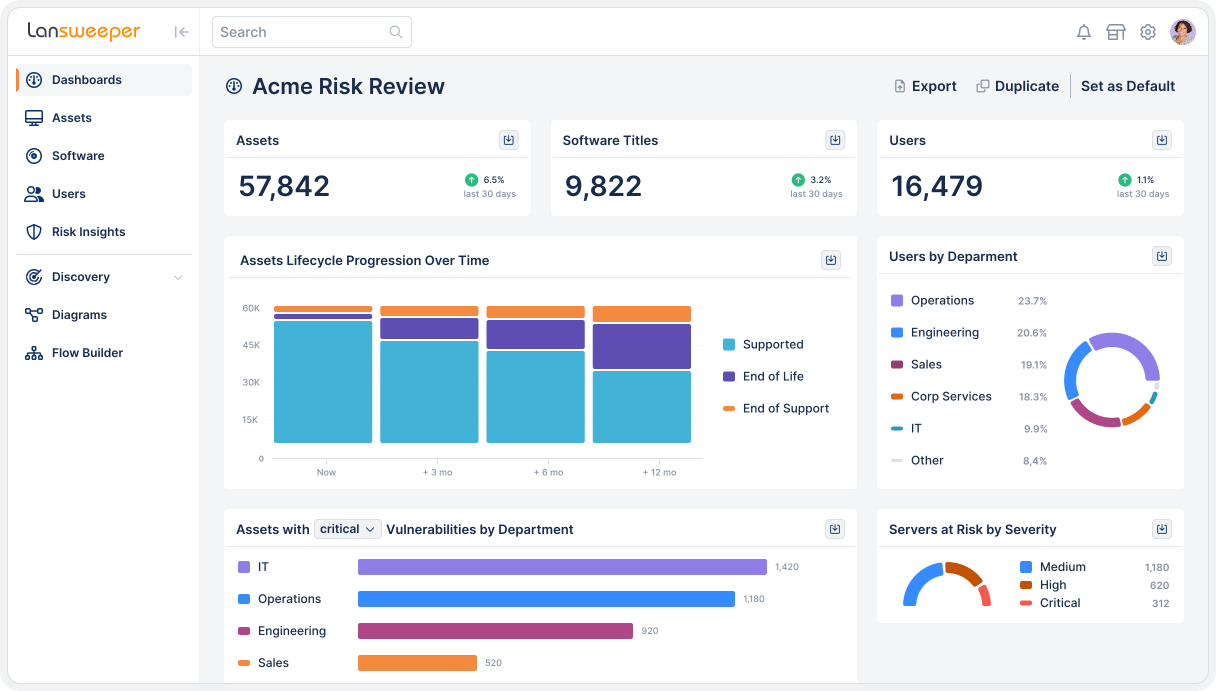
Enforcing policy-based compliance across a complex, changing environment is where most organizations fall short. Lansweeper provides the continuously validated asset intelligence that turns internal policies into operational reality.

Total Visibility
You can’t enforce a policy against an asset you don’t know exists. Lansweeper continuously discovers every IT, OT, IoT, and cloud asset, capturing hardware, software, configuration, and user data across the full cyber estate. Shadow IT is surfaced. Nothing falls outside scope.

Context-Aware Compliance
A configuration baseline for a server shouldn’t govern a developer laptop or an OT device. Lansweeper enriches every asset with ownership, location, lifecycle status, and classification so policies can be scoped by role, department, or criticality. The right standard applied to the right system.

Drift Detection
Every update, user action, and configuration change is a potential drift event. Lansweeper continuously evaluates asset states against defined policy baselines and flags deviations immediately. Non-compliance is caught between audits, not during them.

Audit-Ready Reporting
Internal reviews still require proof. Lansweeper’s customizable reporting lets IT, Security, and GRC teams query any current or historical asset data to generate targeted compliance reports and track changes over time. Evidence is ready when it’s needed.

Orchestration
Detection without action is just noise. Through native integrations, APIs, and Flow Builder, detected violations trigger ITSM tickets, team notifications, asset tagging, and remediation workflows in tools like Intune or Active Directory. Policy compliance becomes an operational process, not a manual one.
How it works
Discover every asset, understand what’s at risk, and push trusted data to the tools that take action.


Continuously discover and classify every asset across IT, OT, cloud, and IoT — managed, unmanaged, and shadow — without manual effort.
Normalize and apply context, vulnerability data, and lifecycle signals to assess risk, forecast spend, and surface optimization opportunities.
Deliver trusted asset intelligence to ITSM, CMDB, and security tools so actions are accurate, scoped, and prioritized.
INTEGRATIONS
Lansweeper feeds trusted, continuously updated asset intelligence into the tools that take action.







Explore the full platform, free for 14 days.
No credit card required.
Yes. Lansweeper continuously evaluates asset configurations against defined compliance baselines and flags deviations as they occur. Historical change tracking provides the context needed to demonstrate ongoing adherence and investigate issues before they become audit findings.
Policy-based compliance is the practice of defining and enforcing adherence to internal IT standards, including configuration baselines, approved software, and access controls, based on an organization’s own governance requirements. Unlike regulatory compliance, it is driven by internal standards rather than external frameworks.
Lansweeper provides the continuously validated asset intelligence needed to define, monitor, and validate internal policies. Enforcement is carried out through integrations with ITSM, endpoint management, and automation tools such as Intune, Active Directory, and Flow Builder, where actions are executed against non-compliant assets.
Teams spend less time on manual compliance work, enforcement becomes consistent across all asset types, and governance programs hold up under both internal review and external audit. Operational risk decreases because the gap between written policy and enforced reality closes.