

Organizations found non-compliant with the EU AI Act face fines of up to €35 million or 7% of global annual turnover for the most serious violations. But the bigger risk for most organizations is not the penalty itself. It is discovering, too late, that they cannot account for the AI systems already operating inside their environment.
A chatbot added to a productivity platform, an AI feature embedded inside a SaaS application, and a third-party tool making automated recommendations behind the scenes are all examples of how AI is becoming increasingly difficult to track. Under the EU AI Act, that lack of visibility creates a serious compliance challenge.
Most organizations do not have a complete picture of where AI exists across their environment.
The European Union’s AI Act introduces the world’s first comprehensive regulatory framework for artificial intelligence. But achieving EU AI Act compliance does not start with policies or paperwork. It starts with answering a much simpler question: Do You Actually Know Every AI System Operating Inside Your Organization?
Without a complete inventory, organizations cannot clearly determine whether they are “provider” or “deployer” or both, classify AI systems according to risk, maintain the required documentation, or demonstrate compliance during an audit.
EU AI Act compliance starts with a single capability: a complete, continuously updated inventory of every AI system operating across your environment. This guide explains who the EU AI Act applies to, what obligations organizations need to prepare for, and why visibility is the foundation of every successful AI governance strategy.
One of the biggest misconceptions about the European AI Act is that it only applies to companies located inside the European Union. In reality, the regulation has a much broader reach.
If your organization develops AI systems sold within the EU, uses AI systems that affect people in the EU, or integrates AI capabilities into products and services available on the European market, you may have EU AI Act obligations, regardless of where your headquarters are located.
Your responsibilities under the EU AI Act depend largely on whether you are considered a provider or a deployer.
Providers develop AI systems or place them on the market under their own name. They are responsible for meeting extensive requirements related to design, testing, technical documentation, risk management, and ongoing compliance.
Deployers use AI systems within their operations. A company using AI for recruitment, employee management, customer interactions, fraud detection, or business forecasting may still have significant compliance responsibilities, even if the AI technology was developed by a third party.
Many organizations will operate as both providers and deployers. A company may develop internal AI models while also using external AI services, creating multiple layers of responsibility.
Understanding your role is the first step. Identifying every AI system that supports that role is the next.
Ask most IT and Security teams how many devices, applications, and services exist across their environment, and the answer is often complicated. Now ask them how many of those assets contain AI capabilities. The answer is usually much less certain.
AI is no longer limited to standalone applications. It is embedded inside cloud platforms, productivity suites, customer relationship management tools, security products, and countless third-party services.
That is why AI governance begins with discovery.
A practical first step toward EU AI Act compliance is building a complete inventory of AI systems and AI-enabled assets across your environment.
This inventory should include:
For every AI system, organizations should document:
This information becomes the foundation for AI classification, risk assessment, documentation, and future audits.
The organizations that struggle with EU AI Act compliance will not necessarily be the ones without AI policies. They will be the ones that never discovered all the AI systems they were already using.
AI Asset Management
Discover where AI runs, how it’s used, and where risk exists.
Another major challenge is understanding what the regulation actually considers an AI system.
The EU AI Act defines AI broadly as a machine-based system that can operate with varying levels of autonomy and generate outputs such as predictions, recommendations, content, or decisions that influence physical or virtual environments.
In practice, this means organizations must look beyond obvious AI tools like chatbots and large language models. A resume screening platform, a customer support assistant, a forecasting model, or a recommendation engine may all fall under the scope of the European AI Act depending on how they function.
At the same time, not every automated technology qualifies as AI. Traditional rule-based workflows, deterministic systems, and standard reporting dashboards may not meet the definition.
The distinction is not always obvious, which is why maintaining accurate, continuously updated asset intelligence becomes essential.
Once organizations identify their AI systems, the next step is understanding how those systems are classified under the EU AI Act.
The regulation follows a risk-based approach. The level of EU AI Act obligations depends on the potential impact an AI system can have on individuals, safety, and fundamental rights.
Certain AI applications are considered unacceptable because they create excessive risks to individuals or society. These systems are prohibited under the EU AI Act.
Organizations should regularly evaluate both existing and newly introduced AI technologies to verify that they do not fall within prohibited categories.
High-risk AI systems are subject to some of the most extensive EU AI Act requirements.
Examples may include AI systems used for:
For organizations operating these systems, compliance involves more than simply documenting their existence. They must establish appropriate governance, maintain technical documentation, implement human oversight, and continuously monitor performance.
But none of these activities are possible if organizations cannot first identify where these high-risk AI systems exist.
The EU AI Act also establishes specific requirements for providers of general-purpose AI models, including many foundation models and large language models.
Organizations using GPAI technologies should understand their responsibilities, evaluate their providers’ compliance commitments, and maintain visibility into where these technologies are used across the enterprise.
The EU AI Act timeline includes multiple phases, and the requirements around August 2, 2026 changed significantly in 2026.
The Digital Omnibus, a legislative package the EU passed to adjust the AI Act’s rollout, changed this timeline. It took effect July 27, 2026. High-risk standalone systems (Annex III) are now deferred to December 2, 2027. High-risk products with AI built in (Annex I) are deferred to August 2, 2028. Article 50 transparency requirements were not deferred. Those took effect on schedule on August 2, 2026.
The extended timeline is not a reason to slow down. Organizations still need to know what AI exists across their environment before they can classify it correctly, regardless of which deadline applies to which system.
Key dates include:

Organizations should use the EU AI Act timeline to prioritize AI discovery, governance initiatives, documentation efforts, and risk assessments.
Preparing for EU AI Act compliance does not begin with creating a policy document. It begins with understanding what AI systems exist, who owns them, and how they affect business operations.
A practical preparation strategy includes:
Develop a continuously updated inventory of AI systems across IT, cloud, SaaS, and third-party environments.
Without this foundation, organizations cannot accurately classify AI systems or determine which EU AI Act requirements apply.
Evaluate whether systems fall into prohibited, high-risk, or other categories under the EU AI Act.
Risk assessments should consider the system’s purpose, affected users, level of autonomy, and potential impact.
Organizations should maintain appropriate evidence, including:
AI environments change constantly. New applications, software updates, and embedded AI capabilities can introduce previously unknown AI systems.
Continuous visibility helps organizations maintain accurate inventories and support ongoing compliance.
EU AI Act compliance does not sit with a single team. The obligations are operational, which means they land across Legal, IT, Security, Product, and Risk. Gaps appear when no one has clearly defined who owns what.
Here is a practical breakdown of responsibilities by function.
Legal teams carry the heaviest documentation burden under the EU AI Act.
Legal should lead the organizational gap analysis against the regulation’s requirements, maintain conformity records for high-risk AI systems, and ensure procurement and vendor contracts reflect AI-specific obligations around intended use, data rights, transparency, and downstream liability.
For organizations operating outside the EU that place AI on the European market, Legal is also responsible for appointing an EU Authorized Representative where required, a formal requirement that carries real accountability.
Legal should also align EU AI Act obligations with existing GDPR and data protection frameworks to avoid conflicting requirements, and coordinate any regulatory interactions or incident notifications if they arise.
IT and Security own the infrastructure that makes compliance evidence possible.
This means building and maintaining the logging pipelines that capture AI inputs, outputs, and human interventions, the records that demonstrate compliance during an audit. Without reliable, time-stamped, tamper-resistant logs, documentation produced by other teams has nothing to stand on.
Security teams should also apply secure development lifecycle controls to AI components, manage access and permissions, monitor for AI-specific threats such as model abuse, prompt injection, and data poisoning, and ensure AI systems are covered in incident response playbooks.
Critically, IT teams are responsible for maintaining a continuously updated inventory of AI-enabled assets across the organization. AI capabilities embedded inside SaaS platforms, cloud services, and third-party integrations are easy to miss, and unknown systems cannot be classified, documented, or governed.
Product teams are responsible for the design-time decisions that determine whether a system meets EU AI Act requirements before it reaches users.
This includes defining the intended purpose of each AI system and its acceptable operational scope, designing human oversight into workflows, publishing clear instructions for use, and ensuring transparency disclosures are in place where the regulation requires them, for example, when users are interacting with AI-generated content or an AI agent.
Product and Operations are also responsible for managing retraining schedules, controlling feature releases, and maintaining rollback procedures. If a system changes significantly after initial deployment, the compliance documentation needs to change with it.
Risk Management maintains the AI risk register and conducts the periodic assessments that determine whether existing controls remain adequate as systems and environments evolve.
This function should verify that high-risk AI systems have the required controls in place, audit the evidence of logging, versioning, and human oversight, and report compliance status, including material risks and open remediation items to leadership on a regular basis.
Internal Audit plays an important role in validating that what teams say they are doing and what is actually happening in production are consistent. This matters because the EU AI Act’s enforcement approach will likely focus on whether organizations can demonstrate active, ongoing oversight, not just whether they produced a policy document.
Senior leaders set the conditions for compliance by allocating resources, assigning accountability, and establishing the organization’s risk appetite for AI use cases.
In practice, this means designating clear owners for high-risk AI systems, ensuring teams have the budget and staffing for oversight, testing, and documentation, and being prepared to sign declarations of conformity where applicable.
It also means treating the current timeline as an operational priority with board-level visibility, not a compliance team deliverable that leadership reviews once it is finished.
The most common failure point is not that individual teams miss their responsibilities, it is that teams work from different inventories of AI systems and never reconcile them. Legal may be aware of AI tools procured through vendor contracts. IT may have discovered additional AI capabilities through network scanning. Product may be developing AI features that have not yet been flagged for risk review.
A shared, continuously updated AI asset inventory is what allows these teams to work from the same picture. Without it, compliance efforts across functions are building on different foundations.
The biggest challenge facing many organizations is not understanding the EU AI Act itself. It is knowing where to begin.
Before teams can classify AI systems, determine whether they are high risk, collect documentation, or demonstrate compliance during an audit, they need visibility into the technologies operating across their environment.
AI systems are already embedded across productivity platforms, customer service applications, security tools, HR technologies, and cloud services. Without a reliable way to discover these assets, organizations may be making compliance decisions based on incomplete information.
Lansweeper’s AI Asset Management gives IT and Security teams a single, continuously updated view of every AI tool, service connection, and AI-capable device across their environment, tied to individual assets, flagged by risk level, and ready to act on.
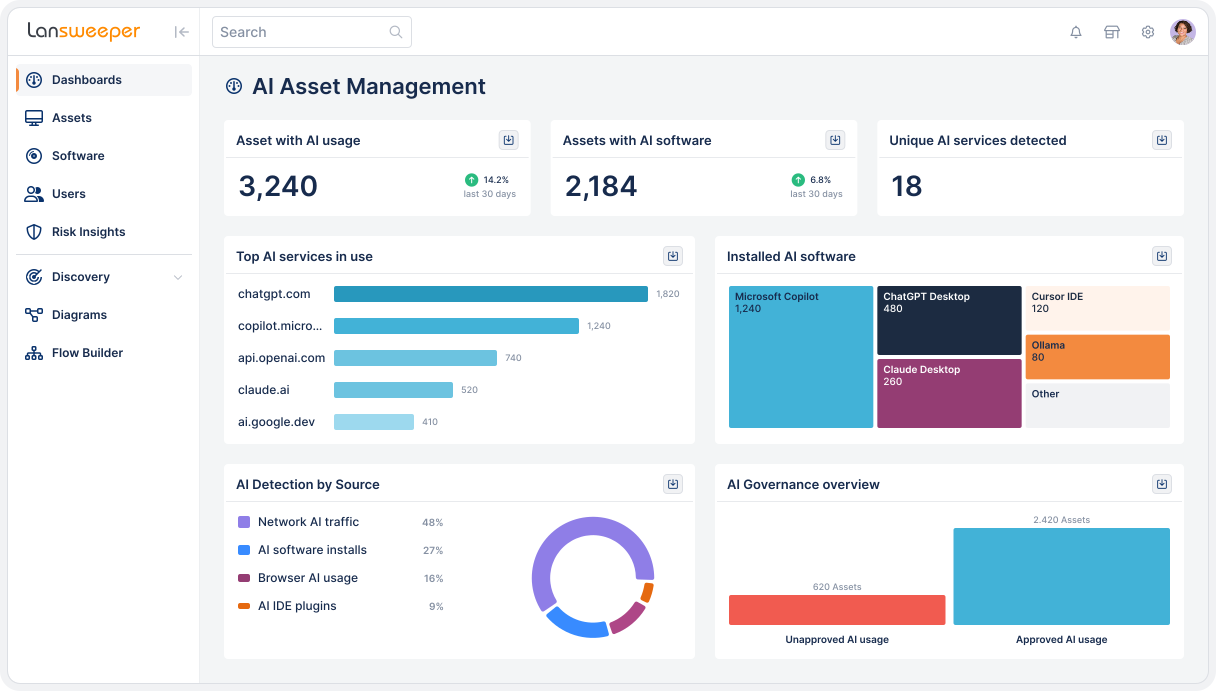
With Lansweeper, organizations can:
The EU AI Act requires organizations to move from assumptions to evidence. That journey starts with knowing what AI technology exists, where it is operating, and who is responsible for it.
Organizations cannot govern AI they cannot see. With high-risk obligations now phased through 2027 and 2028, organizations should use the extra time to establish visibility into their AI ecosystem, understand their responsibilities, and build the documentation and governance processes the European AI Act requires, rather than treating the extended timeline as a reason to wait.
Lansweeper provides the trusted asset intelligence organizations need to identify AI systems, strengthen governance efforts, and approach EU AI Act compliance with greater confidence.
Lansweeper Demo
Sit back and dive into the Lansweeper interface & core capabilities to learn how Lansweeper can help your team thrive.
Frequently asked questions about the EU AI Act.
The EU AI Act, also known as the European AI Act, is a regulatory framework that governs the development, deployment, and use of artificial intelligence using a risk-based approach.
The regulation applies to AI providers, deployers, importers, distributors, and organizations whose AI systems or AI outputs affect individuals within the European Union.
High-risk AI systems are applications that can significantly affect health, safety, fundamental rights, employment opportunities, access to essential services, or critical infrastructure.
Depending on their role and the AI system involved, organizations may need technical documentation, risk assessments, testing records, governance evidence, monitoring records, and other compliance documentation.
A general-purpose AI model is a model capable of supporting multiple downstream applications, including many foundation models and large language models.
Non-compliance can result in enforcement actions, restrictions on AI systems, and substantial financial penalties depending on the severity of the violation and the applicable EU AI Act obligations.
Yes. The Digital Omnibus, which took effect July 27, 2026, deferred high-risk obligations under Annex III to December 2, 2027, and Annex I embedded products to August 2, 2028. Transparency requirements under Article 50 were not deferred and took effect as originally scheduled on August 2, 2026.
Blog


Explore the full platform, free for 14 days.
No credit card required.