93% of organizations don’t know how many assets they own. They generally have between 25% and 40% more devices more than they think they have. And you cannot protect what you don’t know you have.
That statistic is the kind of number that stops you cold. It doesn’t just describe a technical gap. It describes a business risk that every MSP in the world is either solving for their clients right now or leaving wide open.
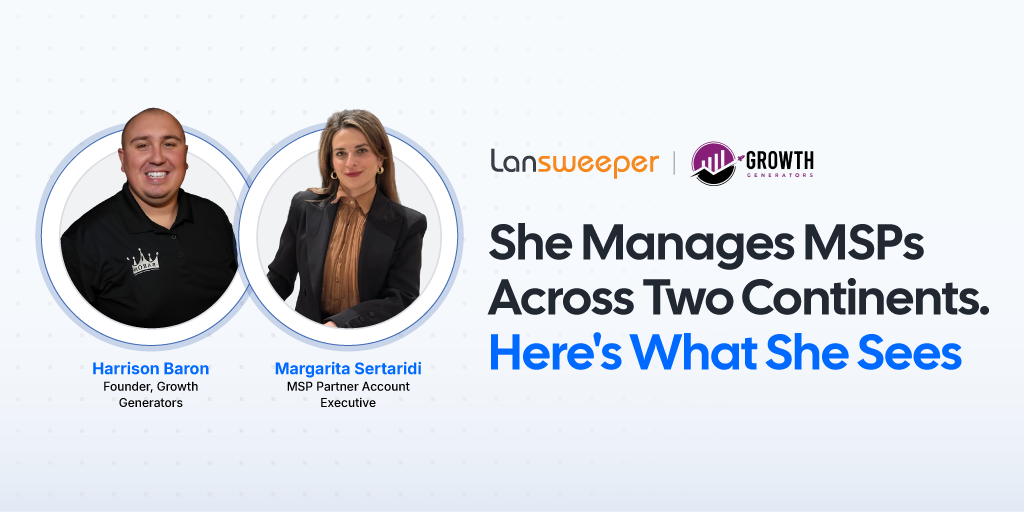
Margarita Sertaridi, Partner Account Executive for MSP EMEA at Lansweeper, recently sat down with Harrison Baron of Growth Generators for one of the most wide-ranging, energetic, and genuinely insightful conversations to hit the MSP Heroes Podcast this year. No fluff. No rehearsed talking points. Just a sharp, honest conversation between two people who know the MSP world inside out.
It comes in tandem with Margarita’s standout session at MSP Day Italy: “Turn Data into Dollars.” That session presents a completely different way of thinking about cyber asset intelligence. This interview gives you everything that didn’t fit in the slides.
“MSPs Cannot Grow if They Do Not Have 100% Visibility.”
That is Margarita’s opening thesis, and it is to be taken literally. Clarity means knowing exactly what is in every client environment: every device, every application, every connection, every risk. Not approximately. Not last quarter. Right now.
Her path to Lansweeper is a story worth hearing. Margarita’s background isn’t purely technical. It’s in business, economics, and growth strategy. She came into the MSP world driven by one question: how do you build organizations that actually scale? And the answer she kept finding, across every role and every market she worked in, was the same: technology is the catalyst, and the MSPs who get the technology foundation right are the ones who grow.
“I joined this team because I wanted to build,” she tells Harrison. “I wanted to help MSPs do even greater.”
What she brings to that mission is the perspective of someone who has worked across some of the most diverse and competitive managed services markets in the world. This conversation is not a North America-centric, but a genuinely global view of what’s working, what’s changing, and where the opportunity is emerging.
The Buying Behavior Breakdown That Every MSP Needs to Hear
One of the most fascinating sections of this interview is when Harrison asks Margarita about how buying behavior shifts across different regions and cultures. She identifies three key elements that define how MSP clients make buying decisions: price sensitivity, speed of trust, and infrastructure reality.
Metropolitan areas demand tighter SLAs, faster response times, and cloud-first solutions. More rural or regional clients soften the SLAs but build longer, deeper relationships before any commercial discussion happens. Northern European markets are process-driven. They want to understand the methodology before they care about the outcome. Southern EMEA markets flip that: outcome first, process second. What is the ROI? What do I get?
“The tools are international. But the buying experience changes, not just by country, but region by region within the same country. The MSPs who understand this distinction are the ones building resilient, sticky client relationships across borders.”
The strategic implication she draws from this is immediately actionable: keep your tech stack stable, adjust your messaging. The most successful MSPs she works with have a rock-solid core of tools they know deeply and they present those tools differently depending on who they’re talking to. They don’t chase every new solution that comes to market. They go deep on what they have, make the most of it, and communicate its value in the language their clients actually speak.
Simplicity Beats Complexity Every Single Time
Margarita’s closing message to Harrison’s audience is the one that landed hardest and it’s the one most worth repeating: “Simplicity beats complexity on every level.”
She’s an economist by training. She loves the Pareto principle: 20% of your efforts produce 80% of your results. She sees MSPs violating this principle constantly: adding tool after tool, chasing every new platform, spreading their teams thin across technologies nobody fully understands.
The MSPs she sees growing 30% year over year aren’t doing more. They’re doing less, but better.
“We have seen MSPs (by implementing the right strategy with the right tools) growing 30% year over year. And that’s an average.”
Her prescription is straightforward: choose your vendors wisely. Learn them properly. Implement them exceptionally. And then sell services, not tools. You cannot solve a revenue problem by selling more products. You solve it by delivering outcomes so clearly that clients renew without negotiation.
“Be simple. Have a specific tech stack. Invest your resources there. Learn it really well. Implement it exceptionally.” It sounds obvious when she says it. But so many MSPs are doing the opposite and wonder why growth feels so hard.
Growth vs. Scalability: The Distinction Most MSPs Miss
Margarita draws a distinction that most MSP owners treat as the same thing but that actually require completely different moves: growth vs. scalability.
Growth means expanding your resources to handle more volume. You win more clients, you hire more people, you buy more tools. The costs go up with the revenue.
Scalability means getting a greater impact from a fixed number of resources. The same team, the same tools, delivering more value, without proportionally increasing what it costs to deliver it.
“MSPs can scale with the same investment, without having to invest more resources.” The path to scalability, in her experience, runs directly through cyber asset intelligence. When you know exactly what’s in every client environment, when your team isn’t spending the first hour of every engagement figuring out what they’re actually dealing with, you can serve more clients, more efficiently, with the same headcount.
“Most MSPs think they have a growth problem. It’s actually a scalability problem and the fix starts with total visibility.”
What IoT, Shadow AI, NIS2 and Dora Mean for Your Business
The second half of this interview gets into the forces that are reshaping the MSP landscape right now. Margarita’s perspective, coming from the markets where these trends hit first, is genuinely ahead of the curve.
- The IoT and shadow AI problem: Margarita flags the rise of unmanaged IoT devices and shadow AI as the next major attack surface expansion. MSPs are already managing environments where clients are running AI tools that nobody has catalogued, or that are connected to networks that aren’t fully inventoried. You cannot protect what you cannot see, and the scale of the unknown is growing every year.
- The DORA and NIS2 opportunity: For European MSPs especially, the regulatory wave is building fast. NIS2 and DORA require rapid adoption across organizations that are nowhere near ready, and the MSPs who get ahead of the compliance curve are now the ones who will own that conversation with their clients. “MSPs need to adapt to that need immediately and offer their services to their end customers.” This isn’t a risk. It’s a growth lever.
- The trend leaders: UK and German MSPs are setting the pace. Southern EMEA follows, and the knowledge sharing across the ecosystem means that what works in the north today will be standard practice everywhere within 18 months. Know where the market is going by watching where its pioneers are today.
The Number That Changes Everything
Back to where we started: 93% of organizations cannot accurately locate the number of assets they have. They’re missing 25 to 40% more than they think.
“You cannot protect what you don’t know that you have.” Margarita says, and this lands differently coming from someone who has seen this play out across hundreds of client environments across two continents. “This is the cornerstone of what Lansweeper does. It lets you know what you have, and then it highlights ways to protect your assets.”
The MSPs who are building their businesses on the foundation of total visibility, who can walk into any client engagement and know, within hours, exactly what they’re dealing with, are the ones who will never have that conversation with a client after an incident that shouldn’t have happened.
40 Books a Year and Still Taking Notes
One final detail from this interview that tells you everything about who Margarita is: she reads close to 40 books a year. She read Harrison’s book — The MSP Growth Playbook — and came to this interview having already taken notes on how to apply its frameworks to her own workshops with MSP partners.
“I’m also here to learn things from you,” she tells Harrison. “In order to be able to build, you should always be a learner.”
That’s the energy she brings to her work with MSPs across EMEA, and it’s the energy that makes this interview worth 30 minutes of your time.
What Total Visibility Looks Like for MSPs
Margarita’s message, from the MSP Day Italy stage to the Growth Generators studio, is consistent: the MSPs who get clarity first build the businesses that scale. The ones who don’t are forever reacting to environments they never fully understood.
If you want to understand what Lansweeper’s asset intelligence platform looks like inside your specific environments, your client base, and your growth strategy, let’s have that conversation.
Get in Touch
Book a call with the Lansweeper MSP team
No generic demo. A real conversation about your business with people who understand what you’re building and want to help you grow it.