

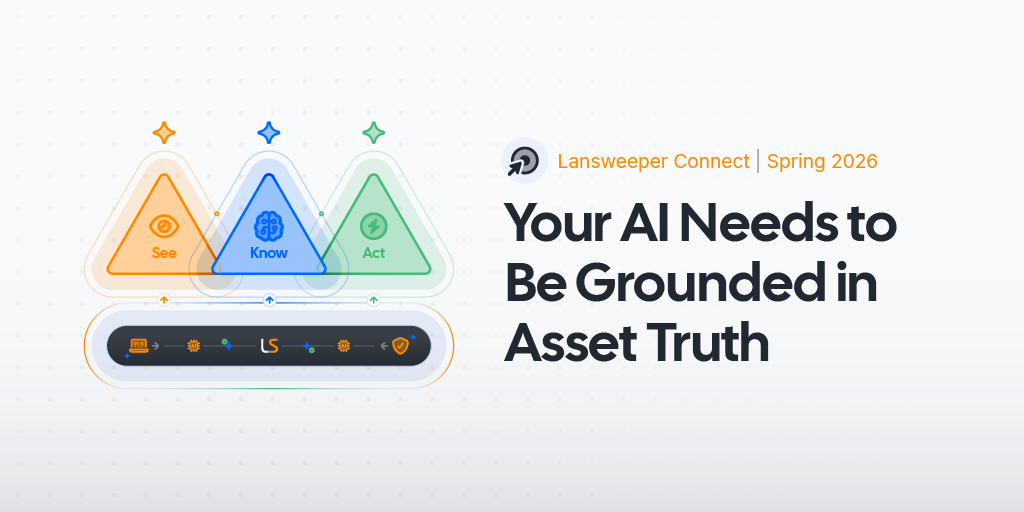
Summer is right around the corner. Holidays are booked, bags are packed. But before all of our colleagues start disappearing from the office, we still have some time for Lansweeper Connect – Spring 2026. This edition we focused on the essential role that asset intelligence and trusted context play in the age of AI.
Our elite team of Lansweeper visionaries once again came together to face the challenge that was on everyone’s mind: AI is only as effective as the data it relies on. Throughout the event, they explored how Lansweeper, as an AI Cyber Asset Intelligence Platform helps organizations build the foundation AI actually needs: asset data that is Complete, Consistent, and Current. Every announcement, every demo was built around a simple framework: See every asset. Know what matters. Act with confidence. All these capabilities work together to create a single source of asset truth that IT teams, security teams, and AI systems can all trust.
Let’s recap what we learned.
AI is no longer a future consideration for IT and security teams, nor is it optional. It’s already everywhere: embedded in workflows, products, service desks, security operations, and increasingly, in the decisions being made across the enterprise.
Organizations will need to adapt. As AI adoption accelerates, we need to ask ourselves one question that is the foundation for everything.
What does your AI actually know?
Because before an AI agent can investigate an incident, assess risk, recommend an action, or trigger a workflow, it asks itself the same first question: What do I know?
And what it knows is only ever what your organization already knows about itself. The quality of the answers your AI agent can provide depends entirely on the quality of the asset data beneath it. If an organization has blind spots, conflicting data, or outdated information, AI won’t stop to think and solve those problems first. It acts on what it can see, with full confidence, at machine speed.
The organizations that succeed with AI won’t necessarily be the ones with the most sophisticated agents. They’ll be the ones with the most trustworthy foundation.
Troy Kitch, VP of Product Marketing, walked us through the three data challenges that continue to undermine both human and AI-driven decision making: completeness, consistency, and currency.
You can’t act on what you can’t see. Unknown devices, unmanaged assets, shadow IT, shadow AI tools, and transient systems all create blind spots that neither people nor AI can account for.
If an asset isn’t visible, it effectively doesn’t exist to an automated system.
Most organizations have multiple versions of the truth. IT, Security, CMDBs, endpoint tools, cloud platforms, and inventory systems often all have a different view of your environment, providing different answers to the same questions.
When AI is working with conflicting data sources, the input can’t be trusted, so neither can the output.
Environments change constantly. New vulnerabilities appear daily. Devices connect and disconnect. Software changes. Users adopt new tools. Yet many organizations still make decisions using information that is hours, days, or even weeks old.
Fast decisions made on stale data don’t reduce risk. They accelerate it.
Together, these challenges create the problem Lansweeper has focused on solving for two decades: give every IT and security team the trusted, continuously validated cyber asset intelligence they need.
In other words: Complete, Consistent, Current Asset Truth.
In this first product section, we focused on closing the completeness gap. Everything starts with knowing what you have.
Traditional discovery starts with what you already know. Traffic sensor approaches visibility differently.
It passively monitors network traffic, surfacing devices the moment they start communicating on the network. This includes assets that may never appear through scheduled discovery alone, like unmanaged devices, transient systems, contractor equipment, and previously unseen assets.
Instead of relying solely on planned discovery, you gain activity-driven visibility across the environment.
Traffic sensor is in open Beta.

AI Usage tracking and the related dashboard were designed specifically for the growing challenge of AI governance. AI tools are already everywhere in your environment. As adoption accelerates, visibility becomes the first prerequisite for governance. You can’t govern your AI tools, if you don’t know where they are.
With the new AI usage tracking capability, you can discover and track:
All gathered in one centralized dashboard.

Another major step toward total visibility is IP Range Coverage.
Rather than viewing discovery one asset at a time, IP Range Coverage helps you find the visibility gaps at the network segment level. It segments your environment by IP range and helps you identify where coverage is strong and where blind spots still exist.
The result is a more complete picture of the environment and greater confidence that no coverage gaps escape your attention.
Visibility alone isn’t enough. Once assets are discovered, you need context. Who owns them? How critical are they? What risks are attached to them? What should happen next?
When you’re in the middle of an incident, you don’t need a list of assets, you need answers. You need a live view of the context: What is affected? Who owns it? How might it affect other systems?
Lens Chat allows you to interact with their asset intelligence using natural language to build the right view for every question. Instead of building reports or writing queries, you can ask your questions directly:
Lens returns grounded answers based on trusted asset intelligence, helping your investigation move to understanding faster.
Lansweeper Lens Chat is in open Beta.

Your dashboard experience continues to evolve. Dashboards are most valuable when they reflect how your organization actually works. With Derived Fields, you can create your own custom data fields based on the logic, definitions, and conditions that matter to you, think risk scores, asset classifications, and business criticality ratings. Or you can get started quickly with ready-made dashboard templates built around common IT and security use cases.
You now know where you stand in your own environment. But how does that compare to others? That’s where Collective Intelligence comes in.
By leveraging insights from more than 30,000 environments, you gain the additional context not just from your own estate, but also those of your industry peers. This external perspective helps you prioritize effort, identify unusual patterns, and benchmark against broader industry trends.

What happens once you have your trusted context? Visibility and intelligence only create value when they drive action.
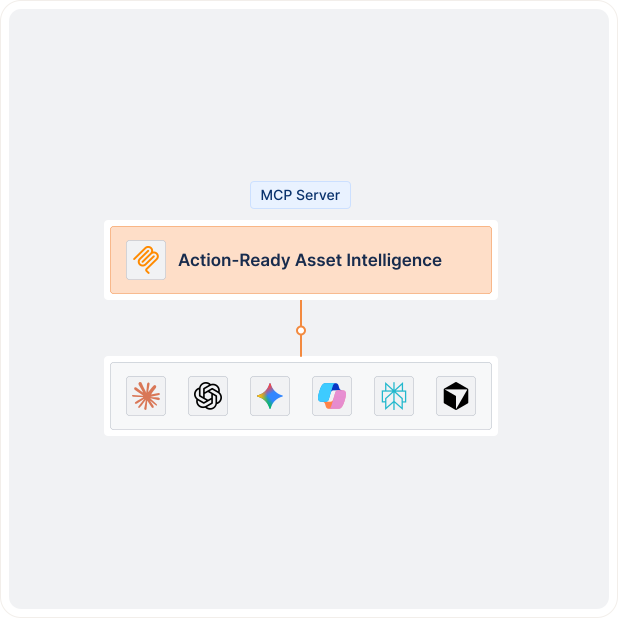
One of the most significant additions to Lansweeper from the past few months is the Lansweeper Lens MCP Server.
The MCP Server allows your AI agents to securely query Lansweeper as a trusted source of asset intelligence. Instead of operating from data silos and assumptions, agents can connect to Lansweeper to retrieve structured answers grounded in trusted, reconciled asset data.
This gives your AI systems access to the context they need so you can trust their outcomes and decisions while ensuring governance and access controls remain intact.
You are probably familiar with Flow Builder by now, so we are happy to announce that this capability has also reached the General Availability stage.
When a condition is detected, Flow Builder can trigger actions across IT and Security workflows, helping you move from insight to execution faster.
Everyone can now build automated workflows directly from your asset intelligence. Even better, thanks to pre-built templates for common automation scenarios, it’s easier than ever to get started.
The central message from Lansweeper Connect – Spring 2026 was simple: AI has become a permanent part of IT and security operations. But AI alone won’t create better outcomes. The organizations that benefit most from AI will be the ones that establish a trustworthy foundation for it.
That means asset intelligence that is:
Because before AI can act with confidence, it needs asset truth.
Lansweeper Connect
Our Lansweeper Connect – Spring 2026 event was filled with exciting new stuff: Check out all the new capabilities and features.
Blog

Explore the full platform, free for 14 days.
No credit card required.