On March 23, 2026, the Federal Communications Commission (FCC) instituted a ban on the import of consumer Wi-Fi routers manufactured outside the US, citing national security risks. The rule is aimed at the consumer market, but it does raise concerns about the impact if it were expanded to include enterprise‑grade networking equipment. Most networking hardware today depends on global supply chains.
Our data, based on millions of devices across US networks, shows that majority of business routers come from vendors who might be affected by a similar ban, as they rely at least partially on production abroad. This raises an important question: is this a one-off measure for consumers, or the start of a broader shift in how networking equipment is regulated?
What Is the FCC Ban on Foreign-Made Wi-Fi Routers?
The FCC’s new rule is a ban on the sale of any newly introduced Wi-Fi routers that are manufactured outside the United States. Existing devices that are already in people’s homes or on the market are considered already approved and remain unaffected. Any new consumer-grade router entering the US market will now require explicit approval if it is produced abroad, which applies to the vast majority of consumer devices from leading vendors.
Why Is the FCC Implementing this Ban?
The ban is rooted in national security concerns. The FCC points out that foreign-made routers, that are embedded in millions of home networks, can be exploited as entry points for cyberattacks, espionage, and intellectual property theft. Recent incidents, some of which were large-scale campaigns targeting US infrastructure, have proven that consumer networking equipment presents a real threat to national security. By placing these devices on its so-called “Covered List,” the FCC is essentially saying that the risk is significant enough to justify intervention.
What Does this Mean for You?
For now, the impact is largely confined to the consumer market. Enterprises are unlikely to feel immediate effects, as the ban does not extend to enterprise-grade networking equipment. However, it is worth keeping on an eye on how this ban develops. The overwhelming majority of networking hardware vendors rely on manufacturing outside the US. The introduction of stricter scrutiny, approval processes, and potential onshoring requirements could signal a broader shift in how network infrastructure is regulated. Even if enterprises are not directly affected today, it raises the question if similar measures could eventually reach the enterprise segment?
What Does the Data Tell Us?
To understand what this policy could mean in practice, we analyzed a subset of data on router deployments from Lansweeper’s HVMND Collective Intelligence and Fing which includes millions of networked assets across tens of thousands of business and consumer environments. While the ban does not affect these already-deployed devices, the dataset offers a strong proxy for how the market is structured today.
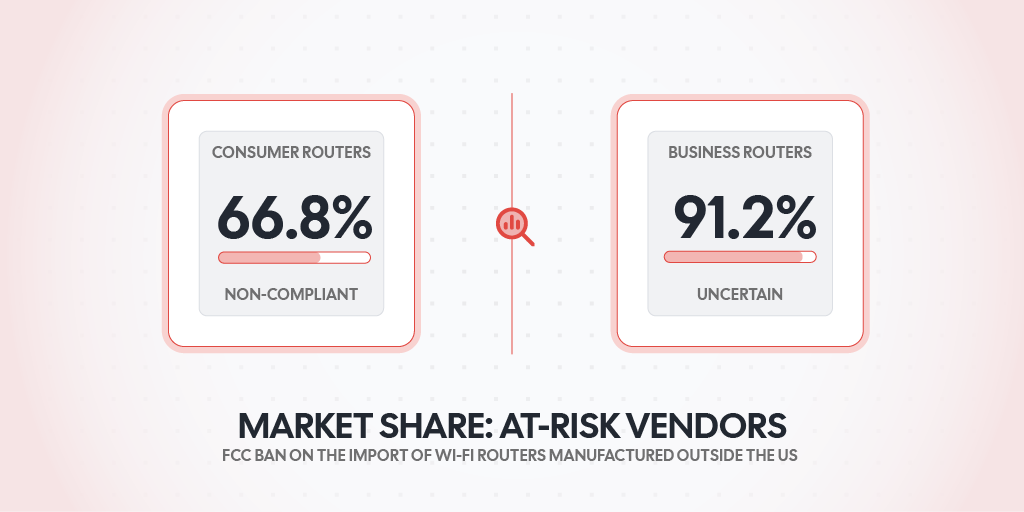
On the consumer side, the picture is stark: just about 2% of routers come from fully compliant vendors, meaning those that manufacture in the US or have already received a conditional approval. 66.6% fall into the non-compliant category. In contrast, business environments look more insulated for now. Only 5.6% of business-owned routers are clearly non-compliant, but a striking 91.2% sit in an “uncertain” category.
This “uncertain” category is not determined by the FCC. Rather we have counted into this category vendors that have their HQ in the US but rely at least partially on manufacturing abroad. Their future depends on how approvals and manufacturing shifts play out. We considered variables such as whether or not a vendor already has (parts of their) production in the US, how likely it is that they could move production to the US, in which countries production currently happens and more.
Based on these variables we had our AI models apply a risk scoring model to the same subset of data, marking how likely a vendor is to be banned under the new rules. Again there’s a stark difference between consumer and business-owned devices: only 17.5% of business routers fall into a higher-risk category (over 50% likelihood of being affected), compared to more than 80% on the consumer side. This suggests that while enterprises are not immediately exposed, the overwhelming reliance on vendors with uncertain compliance status means the market could shift quickly depending on how the FCC’s approval process unfolds.
What if the FCC Ban Expands to Include Enterprise Grade Routers?
While the FCC’s decision is only aimed at the consumer market today, that does not mean that enterprise organizations should simply dismiss it as irrelevant. It is possible that this could be the beginning of a broader regulatory shift that could eventually extend into the business networking space.
- The line between consumer and enterprise is blurry. The definition of “consumer router” is based on how the product is used, rather than to who it is marketed.
- Even vendors of enterprise-grade networking equipment often rely on foreign manufacturing, which is the core trigger of the ban.
- There is precedent from other sectors like telecom and drones where initial scrutiny of consumer products and high-risk vendors later expanded into the enterprise space.
What You Can Do to Prepare
Given this context, it would be wise to prepare for the possibility of an expanded ban, rather than face disruptions later. That starts with gaining visibility:
- Understand where your networking hardware is manufactured.
- Choose vendors with a transparent supply chain.
- Keep close eye on the FCC’s “Covered List”.
- Avoid locking into platforms that could face import challenges in the future.
- Keep an eye on the rules for government procurement. Restrictions tend to appear there first before they reach the broader enterprise market.
In short, while the current FCC router ban may not impact enterprise environments today, it sets a direction. Organizations that start assessing their exposure and adapting their strategy now will be far better positioned should these measures eventually reach the enterprise market.
How Lansweeper Helps You Stay Ahead of Emerging Network Risks
For enterprises navigating this uncertainty, visibility will be key. Acting with confidence starts with a trusted data foundation. Lansweeper’s Cyber Asset Intelligence Platform provides a continuously validated, shared view of your entire network estate, so that both IT and Security teams can rely on the same accurate data when assessing exposure to evolving regulations
Teams gain centralized and continuously updated insights into which routers are in use, how they are distributed, and whether they may be subject to future regulatory changes. This allows you to move beyond reactive decision-making and instead proactively your align vendor strategy, lifecycle planning, and risk management.
As the regulatory landscape around networking hardware continues to evolve, having this level of reliable asset intelligence will be essential to staying secure, compliant, and ahead of disruptions.