

Modern cybersecurity programs promise stronger controls and faster response, but they all depend on one prerequisite: knowing what’s on the network.
You can’t secure what you can’t see. Asset visibility is the foundation of cybersecurity because every security control, policy, and response action relies on accurate knowledge of existing assets, their configurations, and their exposure to risk.
The stakes are high. According to IBM’s Cost of a Data Breach Report 2025, the average cost of a data breach is $4.44 million globally, underscoring how quickly visibility gaps turn into material impact.
In cloud-driven, remote, and constantly changing environments, asset visibility is no longer a basic IT function. It is a core security capability that determines whether cybersecurity strategies successfully reduce risk or leave critical blind spots behind.
Asset visibility in cybersecurity refers to the ability to continuously identify, inventory, and understand all assets connected to your environment.
This includes:
Unlike static inventories or spreadsheets that fall out of date the moment they’re saved, true IT asset visibility reflects a continuously validated view of your environment. Devices come and go. Cloud workloads spin up and down. Remote endpoints reconnect when you least expect them to.
Asset visibility gives you a current, trustworthy view of what exists right now, so you’re not making security decisions based on last week’s data.
Network Discovery
Discover and catalog every connected device in any environment.
Every cybersecurity function depends on asset data, and IT depends on the same data to keep systems running. If an asset isn’t known, it can’t be protected by security or maintained by IT. Asset visibility enables you to:
This makes asset visibility a cornerstone of cybersecurity risk management. Risk is not theoretical, it exists on real devices, software, and services. Knowing what exists allows security teams to measure, prioritize, and reduce that risk effectively.
In short, visibility turns security from guesswork into informed decision‑making.
Customer Testimonial
Zero Trust security models assume no implicit trust. Zero Trust verifies every device, identity, and connection continuously. That principle collapses without asset visibility.
Zero Trust requires answers to questions like:
Asset visibility provides the data layer that makes Zero Trust enforceable. It allows organizations to apply governance policies, segment access, and continuously validate trust based on real conditions rather than static assumptions.
Without IT visibility, Zero Trust becomes a theoretical framework rather than an operational reality.
Cybersecurity blind spots emerge when assets fall outside traditional discovery or management processes. Security teams need to account for these increasingly common blind spots.
Common causes include:
Each blind spot represents potential exposure. Attackers don’t have to breach your strongest defenses; they only need to exploit the device, server, or application you didn’t know was on your network.
This is why improving IT asset visibility is often one of the fastest ways to reduce risk.
Organizations without reliable asset visibility face compounding risks across security, operations, and compliance.
From a security perspective, unknown assets:
From an operational standpoint, lack of IT visibility:
Ultimately, the cost of poor asset visibility isn’t just technical. It shows up as delayed response, increased exposure, and reduced confidence in security decision-making.
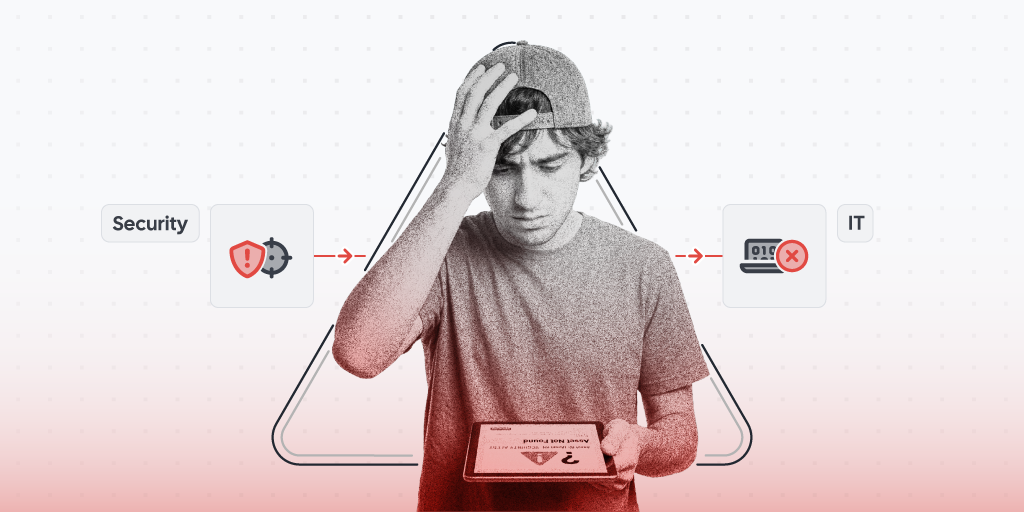
That delay is exactly where vulnerabilities stall between being found and being fixed, a gap we break down in detail in how IT and Security can close the vulnerability remediation gap.
Customer Testimonial
| Category | Purpose/Function | Key Benefits |
|---|---|---|
| Asset discovery & inventory platforms | Identify and track all devices, software, and systems in your environment | Continuous discovery, broad coverage, accurate inventory |
| Cybersecurity asset management solutions | Centralize and enrich asset data to support security decision-making | Supports risk management prioritization, vulnerability management, and governance |
| Risk & exposure management tools | Assess vulnerabilities and exposure across assets | Enables faster response, reduces risk, integrates with workflows |
Using these tools, security teams can move from simply knowing what exists to actively reducing risk, accelerating response, and enforcing governance.
Continuous, automated IT asset discovery gives you continuously validated Cyber Asset Intelligence from across on-prem, cloud, and remote environments so your security team can act faster and reduce risk. Watch the demo today to see how Lansweeper strengthens your cybersecurity posture.
Lansweeper Demo
Sit back and dive into the Lansweeper interface & core capabilities to learn how Lansweeper can help your team thrive.
Asset visibility in cybersecurity is the continuous ability to identify, inventory, and understand every device, software title, and system connected to your environment, including assets IT and security didn’t know existed. It’s what makes every other security control possible, you can’t patch, monitor, or govern an asset nobody knows about. Lansweeper delivers this as continuously validated Cyber Asset Intelligence, covering IT, OT, IoT, and cloud, so both teams work from the same accurate inventory instead of guessing at what’s actually on the network.
It matters because every cybersecurity function depends on knowing what exists. Risk management, patching, monitoring, and incident response all rely on an accurate asset inventory. An asset that isn’t visible can’t be protected or governed, which is why unknown devices are one of the most common entry points attackers exploit. Lansweeper closes that gap with continuous discovery across managed and unmanaged assets, giving security teams the accurate attack surface data they need to prioritize risk instead of reacting to it.
Organizations improve asset visibility through continuous automated discovery, a centralized inventory, and integration with existing security workflows, rather than periodic manual scans that go stale within days. Lansweeper automates this with agentless discovery across on-prem, cloud, and remote environments, then feeds continuously validated asset data directly into the ITSM, CMDB, and security tools IT and security teams already use. Both teams improve visibility from the same dataset instead of running separate, conflicting scans.
A standard discovery tool typically scans on a schedule and stops at whatever it’s configured to look for, missing shadow IT, unmanaged devices, and anything outside its scope. Lansweeper is a Cyber Asset Intelligence Platform that combines active, passive, agent-based, and cloud scanning to continuously validate every asset, managed or not, across IT, OT, IoT, and cloud. It doesn’t just collect data, it cleans and normalizes it into one consistent source of truth that IT and security both rely on.
Without asset visibility, unknown assets miss critical patches, bypass monitoring tools, and create entry points attackers use for lateral movement. Incident response slows down because responders are working from incomplete data, and audits become harder to defend when asset records don’t match reality. We cover this exact failure point, and how to fix it, in our guide on closing the vulnerability remediation gap.
Asset discovery and inventory platforms, cybersecurity asset management solutions, and risk and exposure management tools each address a piece of the visibility problem, from continuous discovery to risk prioritization. Lansweeper combines all three in one platform: agentless discovery finds every asset, enrichment adds risk and lifecycle context, and bi-directional connectors push that data into the ITSM, patching, and security tools teams already use. One dataset feeds every downstream tool instead of separate, unsynced systems.
Most organizations start with agentless discovery across their network to build a baseline inventory, typically complete within days. From there, the platform connects to existing ITSM, CMDB, and security tools so validated asset data flows automatically instead of requiring manual updates.
Blog


Explore the full platform, free for 14 days.
No credit card required.